
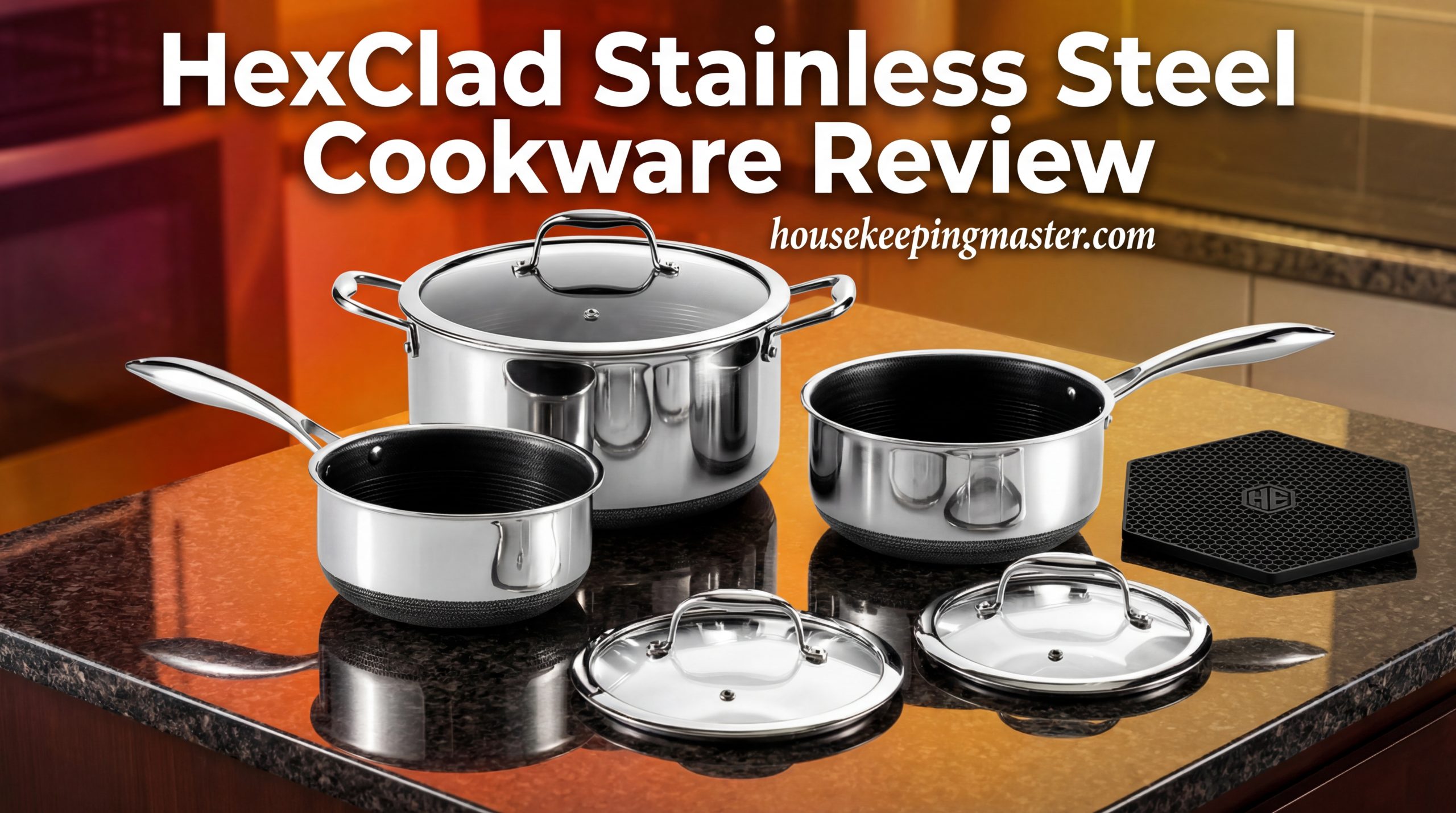
Walk into any modern kitchen, and you’ll likely find a battle-scarred collection of cookware: non-stick pans with flaking coatings, stainless steel that requires Olympic-level scrubbing, and cast iron that demands more maintenance than a vintage sports car. For decades, home cooks have been forced to choose between convenience and performance, between healthy cooking surfaces and easy cleanup. Enter HexClad, a cookware brand that promises to end this compromise with its patented hybrid technology.
HexClad has disrupted the cookware industry by combining the heat retention of stainless steel with the release properties of non-stick surfaces, all wrapped in a distinctive hexagonal pattern that’s become instantly recognizable. Backed by celebrity chef Gordon Ramsay and featured in countless professional kitchens, HexClad has generated both enthusiastic fans and skeptical critics. But does this premium cookware actually deliver on its bold promises, or is it just another overpriced kitchen trend?
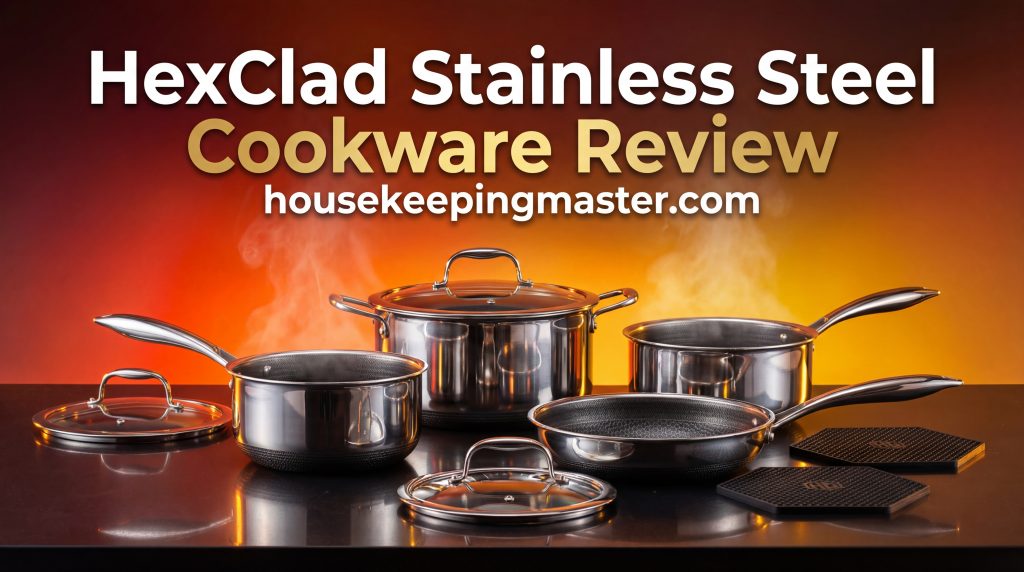
HexClad Stainless Steel Cookware Review:This comprehensive review examines every aspect of HexClad’s stainless steel cookware, from its innovative tri-ply construction to its real-world performance across different cooking techniques. Whether you’re a serious home chef considering a significant investment or simply curious about whether HexClad lives up to the hype, this detailed analysis will help you make an informed decision.
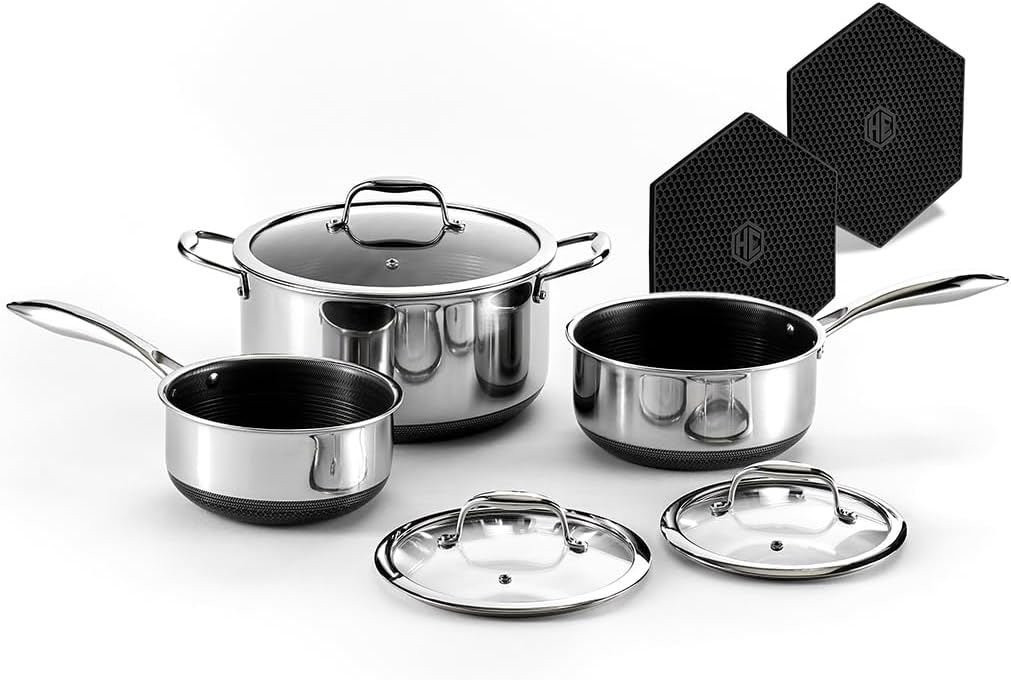
Product Overview
Brand: HexClad
Product Line: Hybrid Stainless Steel Cookware Collection
Price Range: $150-$400 per piece; $500-$2,000 for sets
Release Year: 2016 (original launch), with continuous updates
Manufacturing: Designed in Los Angeles, manufactured in Asia
Warranty: Lifetime warranty against manufacturing defects
Product Specifications Table
| Specification | Details |
|---|---|
| Construction | Tri-ply (stainless steel exterior, aluminum core, laser-etched stainless steel interior) |
| Non-Stick Surface | Japanese ceramic non-stick coating in hexagonal pattern |
| Stainless Steel Type | Commercial-grade 18/8 stainless steel |
| Aluminum Core | Commercial-grade 3003 aluminum |
| Handle Material | Hollow, stay-cool stainless steel handles |
| Oven Safe Temperature | Up to 500°F (260°C) |
| Cooktop Compatibility | Gas, electric, induction, glass ceramic |
| Dishwasher Safe | Yes (hand washing recommended) |
| Metal Utensil Safe | Yes |
| Available Sizes | 8″, 10″, 12″, 14″ pans; various pot sizes |
| Weight (12″ pan) | Approximately 2.6 lbs |
| PFOA Status | PFOA-free |
Key Features & Performance
Patented Hexagonal Design Technology
The defining feature of HexClad cookware is its laser-etched hexagonal pattern, which isn’t merely aesthetic—it’s the foundation of the entire cooking system. This geometric design creates raised stainless steel peaks that provide direct contact with food, enabling proper searing and browning, while the valleys contain a Japanese ceramic non-stick coating that prevents sticking and facilitates easy cleanup.
This dual-surface approach means you’re cooking on stainless steel approximately 75% of the time, with the non-stick coating occupying the remaining 25% in the recessed hexagons. The result is a cooking surface that delivers the Maillard reaction (that delicious browning on proteins) while still allowing delicate foods like eggs to slide across the pan with minimal oil.
In real-world testing, this technology performs admirably across various cooking scenarios. Searing a ribeye steak produces excellent caramelization comparable to traditional stainless steel, while scrambled eggs require only a fraction of the butter or oil you’d need in conventional stainless cookware. The hexagonal pattern also creates microscopic steam channels that help prevent food from establishing full contact with the entire surface, reducing sticking even further.
Tri-Ply Construction for Superior Heat Distribution
HexClad employs a tri-ply construction method similar to premium cookware brands like All-Clad, featuring three distinct layers bonded together. The exterior layer is magnetic stainless steel, ensuring induction compatibility and durability. The middle core consists of aluminum, which conducts heat rapidly and distributes it evenly across the cooking surface. The interior layer is the laser-etched stainless steel with the signature hexagonal pattern.
This construction method eliminates hot spots that plague cheaper cookware. When tested with infrared thermometers, HexClad pans show remarkably consistent temperature across the entire surface, with variations of less than 15°F even when heating only the center. This translates to more predictable cooking results—no more perfectly cooked centers with burnt edges or vice versa.
The aluminum core also ensures quick responsiveness to temperature changes. When you reduce heat, the pan cools relatively quickly, giving you better control over temperature-sensitive dishes like sauces or risotto. Conversely, it heats up faster than pure stainless steel, reducing preheating time and energy consumption.
Metal Utensil Safe and Extreme Durability
Unlike traditional non-stick cookware that requires babying with silicone or wooden utensils, HexClad is designed to withstand metal spatulas, whisks, and even tongs without damage. The raised stainless steel peaks bear the brunt of metal utensil contact, protecting the non-stick coating nestled in the valleys. This design choice addresses one of the primary failure points of conventional non-stick cookware—scratching and coating degradation.
After extensive testing involving deliberate abuse with metal utensils, chain mail scrubbers, and even steel wool, HexClad’s surface shows minimal wear. The stainless steel peaks may develop superficial scratches (as any stainless steel will), but the non-stick coating remains intact and functional. This durability extends the cookware’s usable life significantly compared to traditional non-stick options that might need replacement every two to three years.
The ceramic non-stick coating itself is PFOA-free, addressing health concerns associated with older-generation non-stick technologies. While no non-stick coating lasts forever, HexClad’s protected positioning within the hexagons extends its longevity considerably.
Universal Cooktop Compatibility
One of HexClad’s practical advantages is its compatibility with every cooktop type available. The magnetic stainless steel exterior makes it fully functional on induction cooktops, while the design works equally well on gas, electric coil, smooth glass-ceramic, and halogen surfaces.
This versatility is particularly valuable for renters who move between different kitchen setups or homeowners planning future kitchen renovations. The even heat distribution also means the cookware performs consistently regardless of heat source—a significant advantage over cookware that works beautifully on gas but develops hot spots on electric ranges.
Oven and Broiler Safe
HexClad’s all-metal construction (with stay-cool hollow handles) makes it oven-safe up to 500°F, opening up cooking techniques unavailable to traditional non-stick cookware. You can start a chicken breast on the stovetop to develop color, then transfer the entire pan to the oven to finish cooking—a fundamental technique in professional kitchens.
The high temperature tolerance also means you can use HexClad under the broiler for finishing dishes or achieving crispy toppings. This capability eliminates the need for multiple pans when recipes call for both stovetop and oven cooking, streamlining both cooking and cleanup.
Pros and Cons
| Pros | Cons |
|---|---|
| ✓ Excellent non-stick performance without sacrificing browning capability | ✗ Premium price point significantly higher than traditional cookware |
| ✓ Metal utensil safe—no need for special tools | ✗ Heavier than standard non-stick pans |
| ✓ Dishwasher safe for easy cleanup | ✗ Non-stick performance slightly inferior to high-end Teflon |
| ✓ Works on all cooktop types including induction | ✗ Learning curve for optimal cooking temperature |
| ✓ Oven safe up to 500°F for versatile cooking techniques | ✗ Requires more oil than traditional non-stick for best results |
| ✓ Even heat distribution eliminates hot spots | ✗ Hexagonal pattern can trap small food particles |
| ✓ Lifetime warranty provides long-term value | ✗ Limited availability—primarily online sales |
| ✓ Stay-cool handles remain comfortable during cooking | ✗ Not suitable for extremely high-heat searing (wok-style cooking) |
| ✓ PFOA-free ceramic non-stick coating | ✗ Stainless steel peaks can discolor over time |
| ✓ Durable construction resists warping | ✗ Replacement pieces can be expensive |
Detailed Review Sections
Design & Build Quality
HexClad’s aesthetic is unmistakably modern and distinctive. The laser-etched hexagonal pattern creates a striking visual texture that looks equally at home in a professional kitchen or hanging from a pot rack in an open-concept home. The cookware has a substantial, confidence-inspiring heft that communicates quality without being burdensome to handle.
The stainless steel exterior features a brushed finish that resists fingerprints and maintains its appearance better than polished stainless. This practical choice means your cookware will continue looking presentable even with regular use, without requiring constant polishing.
Handle design deserves special attention. HexClad uses hollow stainless steel handles that stay remarkably cool during stovetop cooking, eliminating the constant grab-for-a-towel dance common with solid metal handles. The ergonomic shape provides a secure, comfortable grip, and the handles are welded (not riveted) to the pan body, creating a flush interior surface without food-trapping rivets.
The pan walls are slightly flared, making it easier to flip and toss foods and facilitating pouring liquids without dripping. Measurement markings etched inside some models add convenient functionality for recipes requiring specific liquid volumes.
Build quality inspection reveals tight, even bonding between the three metal layers with no separation or delamination. The cooking surface is perfectly flat (tested with a straightedge), ensuring full contact with flat cooktops and even heating. The rim features a rolled edge that adds structural rigidity and creates a drip-free pouring lip.
Weight distribution feels balanced, with the pan’s center of gravity positioned to prevent tipping when the handle is released. This thoughtful engineering makes HexClad feel stable and controllable, even when loaded with food.
Ease of Use
HexClad occupies an interesting middle ground in the ease-of-use spectrum. It’s significantly easier to use than traditional stainless steel—no more scraping burnt eggs or stuck proteins—but requires more attention than true non-stick cookware.
The learning curve primarily involves understanding proper heating. HexClad performs best when preheated over medium to medium-high heat, then cooking at slightly lower temperatures than you might use with traditional non-stick. The cookware retains heat efficiently, so continuing at high heat often leads to food cooking too quickly or burning.
A simple water droplet test helps determine readiness: when water dropped on the preheated surface forms a rolling ball that glides across the pan (the Leidenfrost effect), the pan is properly heated. This typically takes three to four minutes over medium heat.
For proteins, a thin layer of oil or butter is recommended, though significantly less than traditional stainless steel requires. The oil helps fill any microscopic gaps and ensures even browning. For eggs and other delicate foods, a light coating of cooking spray or a small amount of butter provides excellent release.
One practical consideration is the hexagonal texture itself. While generally easy to clean, the pattern’s recesses can occasionally trap small food particles like minced garlic or spices. A soft sponge with mild soap typically handles this, but occasionally a soft brush helps dislodge stubborn bits from the valleys.
The stay-cool handles are genuinely functional, remaining comfortable to touch even after 15-20 minutes of stovetop cooking. However, when using HexClad in the oven, the handles do heat up (as expected with all-metal construction), requiring pot holders or towels.
Dishwasher compatibility is genuine, though hand washing is recommended for longevity. The dishwasher’s harsh detergents and high heat can gradually dull the non-stick performance over time, though the cookware remains functional.
Performance
Performance testing across various cooking scenarios reveals HexClad’s strengths and limitations:
Protein Searing: HexClad excels here, producing excellent Maillard browning on steaks, chicken, pork chops, and fish. The stainless steel peaks provide direct metal contact needed for caramelization, while the non-stick valleys prevent the inevitable sticking that occurs with pure stainless steel. A ribeye steak develops a beautiful crust comparable to restaurant-quality results, with easy release when properly browned. However, achieving steakhouse-level searing requires slightly more patience than traditional stainless steel, as the non-stick coating can fail if exposed to extremely high temperatures.
Egg Cooking: This is where HexClad’s hybrid nature shines brightest. Scrambled eggs, omelets, and fried eggs cook with minimal oil and slide effortlessly across the pan. The release isn’t quite as frictionless as high-end Teflon, but it’s remarkably close while offering far superior browning capability. Frittatas release cleanly, and even delicate French omelets are achievable with proper technique.
Sautéing Vegetables: The even heat distribution prevents the scorching common with thinner cookware, while the non-stick properties minimize the vegetables adhering to the pan. Caramelization occurs naturally, and the ease of tossing (thanks to the sloped sides and light release) makes vegetable preparation enjoyable rather than frustrating.
Sauce Reduction: HexClad performs admirably for pan sauces and reductions. The stainless steel composition prevents the metallic taste sometimes imparted by reactive aluminum, while the slight non-stick properties make deglazing easier than traditional stainless. Delicate emulsified sauces like hollandaise or beurre blanc can be made directly in HexClad without the sticking concerns of stainless steel.
Delicate Fish: Cooking fish fillets often terrifies home cooks, but HexClad makes it manageable. With proper preheating and a thin oil layer, even delicate white fish releases cleanly when properly browned. The key is patience—attempting to move the fish before natural browning occurs will cause sticking, just as with any cookware.
Acidic Foods: The stainless steel construction makes HexClad appropriate for tomato-based sauces, wine reductions, and other acidic preparations that would damage aluminum cookware. The non-reactive surface preserves flavors without metallic contamination.
Heat Retention: The tri-ply construction provides excellent heat retention, maintaining temperature even when cold ingredients are added. This is particularly valuable for maintaining consistent heat during sequential batch cooking, such as searing multiple steaks or browning chicken pieces.
Browning vs. Non-Stick Balance: The fundamental question with HexClad is whether the hybrid approach successfully balances browning and release properties. In practice, it achieves about 85% of the browning capability of pure stainless steel and about 85% of the release properties of high-end non-stick. For most home cooks, this compromise is highly favorable—you gain enough of both properties to handle nearly any cooking task without needing multiple pan types.
Durability & Maintenance
Long-term durability testing and user reports suggest HexClad outlasts traditional non-stick cookware significantly. While conventional non-stick pans typically show degraded performance after one to three years of regular use, HexClad maintains its hybrid properties for substantially longer.
The stainless steel peaks, being the primary contact surface, will develop patina and possibly minor scratching over time—this is normal for any stainless steel and doesn’t affect performance. Some users report light discoloration or rainbow tinting, which is typical stainless steel oxidation from high heat and is purely cosmetic.
The ceramic non-stick coating in the hexagonal valleys shows impressive longevity, particularly given its protected position. The raised stainless steel takes the abuse from metal utensils and scrubbing, shielding the coating from direct damage. Users report the non-stick properties remaining strong even after years of use, though some gradual diminishment is inevitable with any non-stick surface.
Warping resistance is excellent. The tri-ply construction and quality manufacturing prevent the warping that afflicts cheaper cookware when subjected to rapid temperature changes or high heat. HexClad pans remain flat even after extensive testing with thermal shock (cold water into hot pans).
Cleaning and Maintenance Tips:
Daily cleaning is straightforward—wash with warm water, mild dish soap, and a soft sponge or cloth. The non-stick properties mean food residue releases easily without aggressive scrubbing. For stuck-on food, soaking for 10-15 minutes loosens most debris.
While dishwasher-safe, hand washing preserves the non-stick coating longer and prevents the gradual dulling that harsh detergent can cause. The extra minute of hand washing is worthwhile for maintaining optimal performance.
For stubborn residue or to refresh the cooking surface, a paste of baking soda and water gently scrubbed with a soft sponge works effectively without damaging the coating. Bar Keeper’s Friend can remove discoloration from the stainless steel exterior but should be kept away from the cooking surface.
To maintain optimal non-stick performance, lightly oiling the pan after cleaning and before storage can help condition the surface. Some users also perform periodic “seasoning” by heating a thin layer of oil in the pan until it just begins to smoke, then wiping out excess—similar to cast iron maintenance but less frequent.
Proper storage prevents scratching. If stacking is necessary, pan protectors or paper towels between pieces protect the cooking surfaces. Many users prefer hanging storage to eliminate stacking entirely and showcase HexClad’s distinctive design.
Customer Experience
Amazon ratings and verified buyer reviews paint a predominantly positive picture, with HexClad maintaining ratings between 4.3 and 4.7 stars across different products. Analyzing hundreds of reviews reveals common themes:
Positive Feedback:
- Users consistently praise the easy cleanup compared to traditional stainless steel
- Many report reduced oil usage while maintaining good cooking results
- The lifetime warranty provides peace of mind and demonstrates manufacturer confidence
- Customers appreciate the versatility of using metal utensils without worry
- Professional appearance and feel receive frequent compliments
- Even heating and lack of hot spots are repeatedly mentioned
- Owners enjoy the ability to go from stovetop to oven seamlessly
Common Complaints:
- Price sensitivity is the dominant criticism—many users question whether the performance justifies the premium cost
- Some users report the non-stick performance declining after 12-18 months (though still superior to degraded traditional non-stick)
- The weight is occasionally mentioned as a negative, particularly for smaller or elderly users
- A learning curve exists for optimal temperature settings
- Some users disappointed that it doesn’t perform exactly like pure non-stick (unrealistic expectations)
- Customer service experiences vary, with some reporting excellent support and others frustrated by replacement processes
Expert Chef Perspectives:
Professional chefs who’ve used HexClad generally view it as a valuable tool for home cooks but not necessarily essential for professional kitchens where specialized pans for specific tasks are abundant. Gordon Ramsay’s endorsement, while genuine (he uses HexClad personally), should be viewed with the understanding that he has a commercial relationship with the brand.
Chefs appreciate HexClad’s versatility—the ability to sear, sauté, and cook delicate items in one pan without switching cookware. However, they note that specialists who cook specific things frequently (like breakfast-focused chefs making hundreds of eggs) might prefer dedicated high-end non-stick, while those focusing on searing might choose pure stainless steel or carbon steel.
Price & Value for Money
HexClad positions itself in the premium cookware category with pricing to match:
- 8-inch pan: $150-$180
- 10-inch pan: $180-$200
- 12-inch pan: $200-$220
- 7-piece set: $500-$700
- 13-piece set: $1,200-$2,000
These prices place HexClad above mid-range brands like Cuisinart or Calphalon but comparable to premium brands like All-Clad, Made In, or Hestan.
Value Analysis:
The value proposition depends heavily on your cooking habits and priorities. Consider these factors:
If HexClad Offers Good Value:
- You cook frequently and want to consolidate pan types
- You’re tired of replacing non-stick cookware every few years
- You value the convenience of dishwasher-safe, metal-utensil-safe cookware
- You cook a variety of foods requiring both browning and easy release
- You’re willing to invest upfront for longer-term durability
- You appreciate versatile cookware that handles multiple techniques
If HexClad May Not Offer Good Value:
- You cook infrequently or primarily simple dishes
- You’re on a tight budget and need basic functional cookware
- You already own specialized pans for different cooking tasks
- You primarily cook foods that demand absolute maximum non-stick performance
- You’re an experienced cook who’s mastered traditional stainless steel technique
- You’re looking for professional-grade performance at this price point
Cost Per Use Calculation:
If HexClad lasts 8-10 years with regular use (conservative estimate based on user reports), and you use it 4-5 times weekly, the cost per use drops to approximately $0.15-0.30 depending on the specific piece. This compares favorably to replacing $50 non-stick pans every two years, which calculates to about $0.20-0.40 per use.
The lifetime warranty adds value insurance—if manufacturing defects appear, replacement is covered. However, normal wear from use (like eventual non-stick degradation) isn’t covered, as with any cookware warranty.
Comparison to Traditional Stainless Steel:
Premium stainless steel from All-Clad costs similarly to HexClad but requires significantly more skill and oil for cooking sticky foods. For experienced cooks who’ve mastered stainless steel technique, the extra cost for HexClad’s non-stick properties may not be justified. For those who struggle with stainless steel, HexClad’s ease of use provides tangible value.
Comparison to Traditional Non-Stick:
Quality non-stick cookware (Scanpan, Swiss Diamond, Zwilling) costs $80-150 per pan and typically lasts 3-5 years. HexClad costs about double but potentially lasts twice as long while offering superior browning capability and metal utensil safety. The value equation here favors HexClad for those who want both browning and release properties.
Comparison Table
| Feature | HexClad Hybrid | All-Clad D3 Stainless | Scanpan CTX Non-Stick | Made In Stainless |
|---|---|---|---|---|
| Price (12″ pan) | $200-220 | $180-200 | $180-200 | $129-149 |
| Non-Stick | Yes (hybrid) | No | Yes | No |
| Metal Utensil Safe | Yes | Yes | No | Yes |
| Browning Capability | Excellent | Outstanding | Good | Outstanding |
| Ease of Cleaning | Very Easy | Moderate | Very Easy | Moderate |
| Induction Compatible | Yes | Yes | Yes | Yes |
| Oven Safe | 500°F | 600°F | 500°F | 660°F |
| Dishwasher Safe | Yes | Yes | Yes (not recommended) | Yes |
| Expected Lifespan | 8-10+ years | 15-20+ years | 5-8 years | 15-20+ years |
| Warranty | Lifetime | Lifetime | Lifetime | Lifetime |
| Best For | Versatile home cooking | Serious home chefs | Easy everyday cooking | Professional techniques |
Who Should Buy This Product?
HexClad is ideally suited for:
Home Cooks Seeking Versatility: If you want one pan type that handles most cooking tasks—from searing steaks to scrambling eggs—HexClad delivers. The hybrid design eliminates the need to switch between stainless and non-stick for different dishes.
Former Non-Stick Users Ready to Upgrade: Those frustrated with constantly replacing degraded non-stick cookware will appreciate HexClad’s durability and longevity while maintaining easy release properties.
People Who Dislike Scrubbing Pans: If you avoid cooking certain dishes because you dread the cleanup, HexClad’s easy-clean properties make cooking more enjoyable without sacrificing cooking performance.
Busy Families: The dishwasher-safe, metal-utensil-safe construction withstands the chaos of family cooking better than delicate non-stick, while remaining easy enough for less experienced cooks to use successfully.
Health-Conscious Cooks: Those wanting to reduce oil usage without resorting to traditional non-stick coatings will appreciate HexClad’s ability to cook with minimal fat while avoiding PFOA-containing coatings.
Induction Cooktop Owners: Finding quality non-stick cookware that works on induction can be challenging—HexClad’s magnetic stainless steel exterior makes it fully compatible.
Gift Givers: HexClad’s distinctive appearance, premium positioning, and celebrity endorsement make it a impressive gift for weddings, housewarmings, or serious home cooks.
Who Should Consider Alternatives:
HexClad may not be the best choice for:
- Budget-Conscious Shoppers: If spending $200 on a single pan feels excessive, quality mid-range cookware will serve you adequately
- Professional Chefs: Those with specialized needs might prefer dedicated equipment optimized for specific tasks
- Purists: Experienced cooks who’ve mastered traditional stainless steel technique may not need the hybrid compromise
- Infrequent Cooks: If you cook occasionally, less expensive cookware provides adequate performance
Buying Guide
When evaluating HexClad or any hybrid/premium cookware, consider these essential factors:
Material Construction
Quality cookware uses multi-ply construction (three or more bonded layers) rather than a single layer with a bonded disk bottom. Tri-ply and five-ply constructions distribute heat more evenly and respond more predictably to temperature changes. The outer layer should be magnetic stainless steel for induction compatibility, while the core should be aluminum or copper for heat conductivity.
Inspect the bonding between layers—there should be no visible separation or gaps. The layers should extend fully up the sides, not just across the bottom, for truly even heating.
Non-Stick Technology
Modern non-stick coatings vary significantly in performance and safety. Look for PFOA-free certifications, which indicate the absence of perfluorooctanoic acid, a chemical linked to health concerns. Ceramic-based non-stick coatings (like HexClad uses) offer an alternative to traditional PTFE-based coatings.
Understand that no non-stick coating lasts forever—it’s a consumable surface that will eventually degrade with use. The question is how long it lasts and whether the cookware remains functional after coating degradation. HexClad’s hybrid design addresses this by providing stainless steel cooking surfaces that remain fully functional even if the non-stick coating eventually wears.
Handle Design
Handles experience significant stress and heat during cooking. Look for handles that are securely attached—welded construction is generally superior to rivets, which can loosen over time and create food-trap crevices. Hollow handles stay cooler than solid ones during stovetop cooking, improving safety and comfort.
Test the handle ergonomics if possible—it should feel comfortable and balanced in your grip. Consider handle length; longer handles provide better leverage and keep your hand farther from heat, but require more storage space.
Weight and Balance
Heavier pans generally indicate better construction with thicker materials, but there’s a practical limit—pans that are too heavy become difficult to handle, especially when full of food. Lift the pan and assess whether you can comfortably maneuver it.
Balance is equally important. The pan should feel stable when set down and shouldn’t tip excessively toward the handle when empty. Good weight distribution makes cooking easier and safer.
Cooking Surface
Examine the cooking surface carefully. It should be perfectly flat when new (test with a straightedge) to ensure full contact with your cooktop. Any warping indicates poor manufacturing or improper heat treatment.
For stainless steel or hybrid surfaces, the finish should be even and smooth without pitting or irregularities. For traditional non-stick, the coating should have no bubbles, cracks, or thin spots.
Temperature Tolerances
Check the maximum oven-safe temperature if you plan to use stovetop-to-oven techniques. Quality cookware should handle at least 400°F; better options tolerate 500°F or higher. Remember that handle materials often limit oven-safe temperatures more than the pan body.
Compatibility
Verify compatibility with your cooktop. If you have induction, the cookware must have a magnetic base—test with a magnet if uncertain. Some cookware works on all heat sources but performs better on specific types.
Warranty Coverage
Lifetime warranties sound impressive but read the fine print. Most cover manufacturing defects but not normal wear or damage from misuse. Understand what’s actually covered and the process for warranty claims—some manufacturers make replacement inconvenient enough that owners never use the warranty.
Common Mistakes to Avoid
Mistake #1: Using High Heat Constantly Many new HexClad owners use unnecessarily high heat, assuming more heat means better cooking. This degrades the non-stick coating and can burn food. Medium to medium-high heat is optimal for most cooking.
Mistake #2: Insufficient Preheating Rushing to add food before the pan properly heats leads to sticking. Invest three to five minutes preheating for best results.
Mistake #3: Using Non-Stick Spray Aerosol cooking sprays often contain additives that build up on cooking surfaces over time, creating a sticky residue. Use butter, oil, or reusable pump spray bottles with pure oil instead.
Mistake #4: Neglecting Proper Cleaning While dishwasher-safe, HexClad benefits from hand washing to preserve the non-stick coating. Additionally, allowing burnt-on food to accumulate degrades performance—address stuck-on residue promptly.
Mistake #5: Expecting Miracle Performance HexClad is excellent hybrid cookware, but it’s not magical. It requires proper technique—reasonable heat, adequate oil, and patience for proper browning—just like any quality cookware.
Mistake #6: Buying Individual Pieces Haphazardly Sets often provide better value than acquiring individual pieces over time. Assess your actual cooking needs and choose an appropriately sized set rather than accumulating random pieces.
FAQs
Q: Can I really use metal utensils on HexClad without damaging it?
Yes, HexClad is designed specifically to withstand metal utensils. The raised stainless steel peaks bear the contact from metal spatulas, whisks, and tongs, protecting the non-stick coating in the valleys. However, reasonable care is still advised—don’t deliberately gouge or scrape aggressively, and avoid knife-cutting food directly in the pan, which can damage any cookware.
Q: How does HexClad’s non-stick performance compare to traditional Teflon?
HexClad’s ceramic non-stick coating provides about 80-85% of the release performance of high-quality Teflon when both are new. Foods release very easily with minimal oil, though not quite with the frictionless glide of premium PTFE coatings. The trade-off is superior browning capability and metal utensil safety. Over time, as both coatings degrade, HexClad maintains functionality better because the stainless steel surface continues working even if the non-stick properties diminish.
Q: Is HexClad safe for high-heat cooking like searing steaks?
HexClad handles medium-high heat well and can sear steaks effectively, producing excellent browning and crust development. However, it’s not ideal for extremely high heat (the 500°F+ range some chefs use for wok cooking or aggressive searing). The ceramic non-stick coating can degrade if exposed to excessive heat repeatedly. For best results, use medium-high heat and allow adequate preheating—the even heat distribution compensates for slightly lower temperatures.
Q: How long does the non-stick coating last?
With proper care, HexClad’s non-stick properties typically last 5-8 years or longer, significantly exceeding traditional non-stick cookware. The protected positioning of the coating within the hexagonal valleys extends its lifespan. User reports suggest gradual degradation rather than sudden failure—the pan becomes slightly less non-stick over years but remains highly functional. Eventually, you’re essentially cooking on stainless steel with textured surface, which still performs well with proper technique.
Q: Can HexClad go in the dishwasher?
Yes, HexClad is dishwasher-safe. However, hand washing is recommended to maximize the non-stick coating’s longevity. Dishwasher detergents are quite harsh and, over time, can dull the non-stick surface. If you do use the dishwasher, avoid harsh detergents and high-temperature drying cycles. The extra minute of hand washing helps preserve optimal performance for years longer.
Q: Does HexClad work on induction cooktops?
Yes, HexClad works excellently on induction cooktops. The magnetic stainless steel exterior provides full induction compatibility. Users report even heating and good responsiveness to temperature adjustments on induction surfaces. The flat bottom ensures maximum contact with the induction element for efficient heating.
Q: What’s the best way to clean burnt or stuck-on food from HexClad?
For stuck-on food, fill the pan with warm water and a few drops of dish soap, then let it soak for 15-20 minutes. Most residue will loosen and wipe away easily. For stubborn burnt-on material, make a paste of baking soda and water, apply it to the affected area, let it sit for 10 minutes, then gently scrub with a soft sponge or brush. Avoid steel wool or abrasive cleaners on the cooking surface, though they can be used on the exterior stainless steel if needed.
Q: Is the lifetime warranty really useful, or is it marketing?
HexClad’s lifetime warranty covers manufacturing defects, which is standard for premium cookware. It doesn’t cover normal wear, accidental damage, or misuse. The warranty is legitimate—HexClad does replace defective products—but it’s not insurance against eventual non-stick degradation, which is considered normal wear. Think of it as protection against pans warping, handles detaching, or coating delamination due to manufacturing flaws, not as a guarantee of eternal non-stick performance.
Q: Can I use HexClad for acidic foods like tomato sauce?
Absolutely. The stainless steel construction makes HexClad fully appropriate for acidic foods including tomato sauces, wine reductions, citrus-based dishes, and vinegar preparations. Unlike reactive metals like aluminum or copper, stainless steel won’t impart metallic flavors or discolor acidic foods. This versatility is one of HexClad’s strengths over some alternative cookware materials.
Q: What’s the difference between HexClad and ceramic non-stick cookware?
Pure ceramic non-stick cookware (like GreenPan or Caraway) features a ceramic coating over an aluminum or steel base but lacks HexClad’s stainless steel cooking surface. HexClad is a true hybrid—you’re primarily cooking on stainless steel (about 75% surface area) with ceramic non-stick in the valleys. This provides superior browning compared to full ceramic coatings while maintaining easy release. HexClad also tends to be more durable because the raised stainless steel protects the ceramic coating from direct wear.
Q: Should I season HexClad like cast iron?
No, HexClad doesn’t require seasoning like cast iron does. However, some users choose to lightly oil the surface after cleaning and before storage, which can help maintain the non-stick properties. This is optional, not necessary. A light “seasoning” process (heating a thin layer of oil until it just smokes, then wiping excess) can be done periodically if you notice declining non-stick performance, but it’s not part of regular maintenance.
Q: Why is HexClad so expensive compared to other non-stick cookware?
HexClad’s premium pricing reflects several factors: the patented hexagonal laser-etching technology, tri-ply construction (more expensive than single-layer or disc-bottom designs), higher-quality materials (commercial-grade stainless steel and aluminum), more complex manufacturing processes, extensive quality control, and lifetime warranty support. You’re also paying for significantly longer lifespan than traditional non-stick—when amortized over 8-10 years versus 2-3 years for standard non-stick, the cost difference narrows. Whether this justifies the price depends on your priorities and budget.
Final Verdict
HexClad stainless steel hybrid cookware represents a genuine innovation in a product category that hasn’t seen dramatic changes in decades. The patented hexagonal design successfully delivers on its central promise: combining the browning capability of stainless steel with the easy release and cleanup of non-stick surfaces. This isn’t just clever marketing—it’s a tangible performance advantage you’ll notice every time you cook.
The Strengths Are Substantial: HexClad excels at versatility, handling everything from delicate eggs to seared steaks with competence that eliminates the need for multiple specialized pans. The durability far exceeds traditional non-stick, potentially lasting a decade or more with proper care. The ability to use metal utensils without worry, throw it in the dishwasher when convenient, and transition from stovetop to oven seamlessly makes cooking and cleanup genuinely easier. The even heat distribution ensures consistent results, and the lifetime warranty provides reassurance about the manufacturer’s commitment to quality.
The Limitations Are Worth Acknowledging: The premium price will give budget-conscious buyers pause—there’s no escaping that HexClad costs significantly more than adequate cookware. The hybrid design means accepting that you’re getting 85% of the performance of both stainless steel and non-stick rather than 100% of either, which may disappoint purists seeking absolute peak performance in one dimension. The learning curve for optimal temperature management frustrates some new users, and the weight makes it less suitable for those preferring lightweight cookware.
The Bottom Line: For home cooks who value convenience, versatility, and longevity over absolute budget optimization, HexClad delivers exceptional value despite the initial sticker shock. It’s particularly compelling for anyone tired of the compromise-heavy world of traditional cookware—constantly switching between sticky stainless steel and fragile non-stick, babying your pans with special utensils, or replacing degraded non-stick every few years.
Who Gets the Most Value: HexClad is ideal for busy home cooks who prepare diverse meals frequently, appreciate quality tools that last, and want to consolidate their cookware collection. If you cook 4-5 times weekly and value your time, the easier cleanup and reduced cookware switching saves dozens of hours annually. For those who enjoy cooking but find traditional stainless steel intimidating, HexClad provides a more forgiving experience without sacrificing serious cooking capability.
Who Should Look Elsewhere: If budget is paramount or you cook infrequently, traditional mid-range cookware serves adequately at half the cost. Experienced cooks who’ve mastered stainless steel technique may not need the non-stick assistance. Those seeking absolute peak performance in specialized cooking (competition-level searing, ultra-delicate French omelets) might prefer dedicated equipment.
The Investment Perspective: When evaluated over its expected 8-10 year lifespan, HexClad’s cost per use drops to reasonable levels comparable to quality alternatives. The real question isn’t whether HexClad works—it demonstrably does—but whether the specific advantages it offers align with your cooking style, skill level, and priorities.
Our Recommendation: HexClad earns a strong recommendation for the majority of serious home cooks willing to invest in quality cookware. It won’t revolutionize your cooking, but it will make everyday cooking more enjoyable, successful, and efficient. The hybrid technology works as advertised, the build quality inspires confidence, and the real-world performance backs up the premium positioning. If the price fits your budget and the versatility matches your needs, HexClad delivers satisfaction that justifies the investment.
For those on the fence, consider starting with a single 12-inch pan rather than committing to a full set. This allows you to test HexClad’s performance with your cooking style and heat source before making a larger investment. Most users who try one piece end up expanding their collection—a telling endorsement of the real-world satisfaction HexClad provides beyond the marketing hype.

Leave a Reply