
Electric stoves have become increasingly popular in modern kitchens, offering consistent heat distribution, easier temperature control, and safer cooking compared to gas alternatives. However, not all cookware performs equally on electric stovetops. The flat, smooth surface of electric burners requires specific characteristics in your pots and pans to achieve optimal cooking results.
Best Type Of Cookware for Electric Stoves:Choosing the right cookware for your electric stove isn’t just about compatibility—it’s about maximizing efficiency, preventing damage to your cooktop, and elevating your culinary experience. The wrong cookware can lead to uneven heating, hot spots that burn food, wasted energy, and even permanent scratches or stains on your cooktop surface.
Why Choosing the Right Cookware for Your Electric Stove Matters!
Electric stoves, whether traditional coil or smooth glass-ceramic tops, demand cookware with flat, smooth bottoms that make complete contact with the heating element. This contact is crucial because electric stoves transfer heat through direct conduction rather than the radiant flames of gas burners. Any warping, roughness, or gaps between your pan and the burner means lost heat, longer cooking times, and higher electricity bills.
Material matters significantly when cooking on electric stoves. Stainless steel, cast iron, and aluminum each offer distinct advantages and challenges. Stainless steel provides durability and even heat distribution when constructed with aluminum or copper cores. Cast iron retains heat exceptionally well but takes longer to heat up. Hard-anodized aluminum offers lightweight convenience with excellent heat conductivity. Understanding these material properties helps you make informed decisions based on your cooking style and needs.
Beyond material, factors like weight, handle design, lid quality, and compatibility with other cooking methods (like induction or oven use) all play important roles. You’ll want cookware that feels balanced in your hand, stays cool to the touch where it should, and transitions seamlessly from stovetop to oven when recipes demand it.
The investment you make in quality cookware pays dividends over years of use. Well-chosen pots and pans can last decades with proper care, while cheap alternatives may warp, discolor, or lose their non-stick properties within months. This comprehensive guide will help you navigate the crowded cookware market, understand what truly matters for electric stove cooking, and identify the best options across various price points and cooking needs.
Whether you’re setting up your first kitchen, upgrading worn-out pans, or seeking specialized pieces to complete your collection, this article provides detailed, honest reviews of eleven top-performing cookware options specifically suited for electric stoves. We’ll explore everything from budget-friendly starter sets to professional-grade individual pieces, ensuring you find the perfect match for your cooking style, skill level, and budget.
Top 11 Best Cookware Options for Electric Stoves – Detailed Reviews
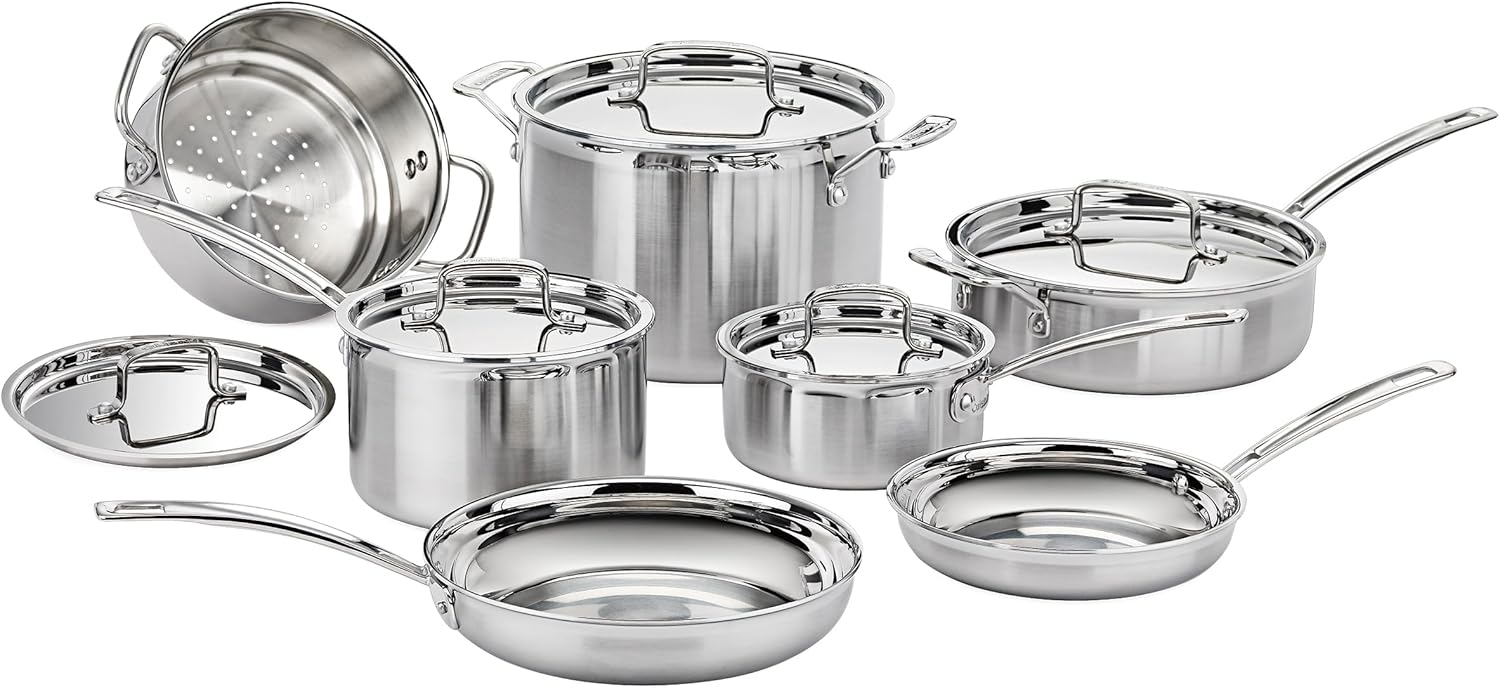
1. Cuisinart Multiclad Pro Stainless Steel 12-Piece Cookware Set

Overview:
The Cuisinart Multiclad Pro represents exceptional value in the premium cookware category, offering professional-grade construction at a fraction of the cost of luxury brands. This comprehensive 12-piece set features triple-ply construction with an aluminum core sandwiched between stainless steel layers, creating cookware that heats evenly and responds quickly to temperature changes—essential qualities for electric stove cooking.
Key Features:
- Triple-ply construction with heat-responsive aluminum core for even heating without hot spots
- Flat, tight-fitting bottoms ensure maximum contact with electric burners for efficient heat transfer
- Cool Grip handles stay comfortable during extended cooking sessions and are riveted for durability
- Drip-free pouring rims on every piece minimize mess and waste
- Oven-safe up to 550°F allowing stovetop-to-oven versatility for finishing dishes
- Dishwasher-safe for convenient cleanup, though hand washing extends longevity
- Compatible with all stovetops including induction, gas, glass, and ceramic
- Includes: 1.5-qt and 3-qt saucepans with lids, 8-qt stockpot with lid, 8-inch skillet, 10-inch skillet, 3.5-qt sauté pan with lid and helper handle
Performance and User Experience:
The Cuisinart Multiclad Pro excels on electric stoves thanks to its perfectly flat bottoms that make complete contact with heating elements. Users consistently report even browning when searing proteins and no scorching in sauces that might burn in lesser cookware. The aluminum core conducts heat efficiently, meaning your electric burner’s energy translates directly into cooking performance rather than being lost to poor contact or uneven distribution.
Temperature responsiveness impresses home cooks accustomed to sluggish heating with cheaper pans. When you adjust your electric stove’s heat setting, these pans respond relatively quickly—not as instantaneously as gas, but noticeably faster than single-layer stainless steel. This responsiveness gives you better control over delicate tasks like making caramel or reducing sauces.
The brushed stainless steel exterior resists staining and maintains its professional appearance even after years of use. While you’ll see some discoloration from high heat over time, proper cleaning with Bar Keeper’s Friend restores the original luster. The interiors develop a patina that actually improves their non-stick properties when properly preheated and oiled.
Handle design deserves special mention—they stay remarkably cool on the stovetop, and their ergonomic shape provides secure grip even when wearing oven mitts. The riveted construction means these handles won’t loosen or detach, a common failure point in cheaper cookware.
Pros:
✅ Exceptional heat distribution eliminates hot spots and burning on electric stoves
✅ Professional-grade construction at mid-range pricing offers outstanding value
✅ Perfectly flat bottoms maintain contact with electric elements for maximum efficiency
✅ Generous 12-piece set covers virtually all cooking needs without redundancy
✅ Oven-safe to 550°F enables versatile cooking techniques
✅ Cool-grip handles stay comfortable even during extended stovetop use
✅ Dishwasher-safe convenience (though hand washing recommended for longevity)
✅ Compatible with all cooktop types including future kitchen upgrades
Cons:
❌ Stainless steel requires proper preheating and fat to prevent sticking with delicate foods
❌ Polishing required to remove heat stains and maintain pristine appearance
❌ Heavier than non-stick or aluminum alternatives, which may challenge some users
❌ Learning curve for those transitioning from non-stick cookware
❌ No non-stick pieces included for eggs or fish
Ideal For:
Home cooks seeking restaurant-quality results without professional pricing. Perfect for those with electric stoves who want versatile, durable cookware that will last decades. Excellent choice for anyone ready to move beyond non-stick coatings and learn proper stainless steel cooking techniques. Particularly suited for households that cook diverse cuisines requiring different pot and pan sizes.
The Cuisinart Multiclad Pro delivers premium performance that rivals cookware costing three times as much. Its engineering specifically addresses the challenges of electric stove cooking—flat bottoms, responsive heating, and even distribution—making it our top overall recommendation for value-conscious buyers who refuse to compromise on quality. The comprehensive set eliminates guesswork about which pieces you need, while the lifetime warranty provides peace of mind. If you’re investing in cookware that will serve you for twenty years or more, this set represents smart spending.
2. T-fal E93808 Professional Total Nonstick Fry Pan Set

Overview:
T-fal has built a reputation for creating reliable, affordable non-stick cookware, and their Professional Total Nonstick series specifically targets home cooks who want effortless food release and easy cleanup on electric stoves. This three-piece fry pan set (8-inch, 10.5-inch, and 12.5-inch) features heavy-gauge aluminum construction with T-fal’s signature Thermo-Spot heat indicator—a practical feature that takes guesswork out of preheating on electric cooktops.
Key Features:
- Thermo-Spot technology with visual indicator that turns solid red when pan reaches optimal cooking temperature
- Heavy-gauge aluminum construction provides even heat distribution and prevents warping
- ProGlide non-stick interior with titanium reinforcement resists scratching and offers superior food release
- Riveted silicone handles stay cool during stovetop cooking and provide comfortable grip
- Flat bottom design maximizes contact with electric burner coils or smooth tops
- Oven-safe to 400°F expands cooking possibilities beyond stovetop
- PFOA, lead, and cadmium-free non-stick coating for health-conscious cooking
- Dishwasher-safe though hand washing extends non-stick longevity
Performance and User Experience:
On electric stoves, these T-fal pans shine—literally. The Thermo-Spot indicator solves one of electric cooking’s biggest challenges: knowing when your pan has reached the right temperature. Unlike gas flames that provide visual feedback, electric burners offer no obvious cue. The red spot turning solid tells you precisely when to add food, resulting in better searing, less sticking, and more consistent results.
The heavy-gauge aluminum heats remarkably evenly across the entire cooking surface. Testing with pancake batter reveals uniform browning from edge to center—no dark spots or pale patches. This even heating matters especially on electric coil burners where heat concentrates in the coil pattern. The thick aluminum dissipates that concentrated heat effectively.
Food release exceeds expectations even compared to other non-stick pans. Eggs slide freely without butter or oil (though a light coating improves flavor and longevity). Delicate fish fillets lift cleanly without tearing. Sticky sauces wipe out effortlessly. This performance remains consistent through hundreds of uses when you avoid metal utensils and excessive heat.
The silicone handles balance comfort and heat resistance beautifully. They stay cool enough to grip bare-handed during typical stovetop cooking, though you’ll want a potholder when using the pans in the oven. The riveted attachment feels secure with no wobble or flex.
Size variety in this three-piece set proves genuinely useful rather than redundant. The 8-inch handles individual servings, omelets, or small portions. The 10.5-inch serves as the workhorse for everyday cooking. The 12.5-inch accommodates family-size meals or batch cooking. Having all three means less crowding and better heat circulation around food.
Pros:
✅ Thermo-Spot indicator eliminates temperature guesswork on electric stoves
✅ Exceptional non-stick performance requires minimal oil or butter
✅ Heavy-gauge construction prevents warping even with frequent high-heat use
✅ Three practical sizes cover diverse cooking needs without redundancy
✅ Affordable pricing makes quality non-stick accessible to any budget
✅ Silicone handles stay comfortably cool during stovetop cooking
✅ Even heating eliminates hot spots common on electric burners
✅ Easy cleanup—most food wipes out with just a paper towel
Cons:
❌ Non-stick coating will eventually wear out with regular use (typically 3-5 years)
❌ Not induction-compatible limits future kitchen flexibility
❌ Cannot withstand metal utensils without risking coating damage
❌ Maximum oven temperature of 400°F restricts some cooking techniques
❌ Lacks lids, requiring separate purchase for covered cooking
❌ Exterior may show staining from electric burner heat over time
Ideal For:
Budget-conscious cooks who prioritize convenience and easy cleanup. Perfect for those who regularly cook eggs, pancakes, fish, or other delicate foods that stick to stainless steel. Excellent choice for apartment dwellers or first-time home buyers setting up kitchens without breaking the bank. Ideal for anyone intimidated by stainless steel or cast iron who wants reliable, user-friendly cookware for their electric stove.
T-fal’s Professional Total Nonstick set delivers outstanding value by focusing on what matters most: performance, durability, and user-friendly features. The Thermo-Spot technology specifically addresses electric stove challenges, making these pans especially well-suited for this cooktop type. While the non-stick coating won’t last forever, the affordable pricing means replacement doesn’t hurt financially. For everyday cooking on electric stoves, particularly when ease of use trumps heirloom durability, this set is tough to beat.
3. Lodge Cast Iron Skillet 12-Inch with Red Silicone Hot Handle Holder

Overview:
Lodge has manufactured cast iron cookware in America since 1896, perfecting an ancient cooking method that remains relevant in modern kitchens. This pre-seasoned 12-inch skillet represents cast iron at its most practical and affordable, offering exceptional heat retention and natural non-stick properties that improve with use. For electric stove owners, cast iron provides unique advantages—particularly the ability to stay hot for extended periods, reducing the electricity needed to maintain cooking temperature.
Key Features:
- Pre-seasoned with vegetable oil for immediate use straight from the box
- Heavy-duty cast iron construction provides superior heat retention and even distribution
- Naturally non-stick surface that improves with use and proper maintenance
- Dual pour spouts enable neat draining of fats and liquids from either side
- Assist handle opposite the main handle aids in lifting when pan is full or hot
- Oven-safe to any temperature including under broilers and in campfires
- 12-inch cooking surface accommodates family-size portions or multiple items
- Included silicone hot handle holder protects hands from cast iron’s heat retention
- Induction compatible works on all cooktop types including induction, gas, electric, and ceramic
Performance and User Experience:
Cast iron’s performance on electric stoves differs markedly from stainless steel or aluminum, requiring understanding of its unique characteristics. The material heats slowly but evenly, making it ideal for electric coil or smooth-top burners that provide steady, consistent heat rather than the instant adjustability of gas. Preheat this skillet for 5-10 minutes on medium heat, and it will maintain that temperature beautifully for the duration of cooking.
Heat retention becomes cast iron’s superpower on electric stoves. Once hot, the pan stays hot even when you add cold ingredients—your steak maintains its sear, your stir-fry achieves that elusive wok hei, your cornbread develops a perfectly crispy bottom crust. This thermal mass also means you can often reduce your electric burner to low or even turn it off entirely during cooking, saving energy while maintaining temperature.
The pre-seasoning from Lodge provides a decent starting point, but the pan truly excels after you’ve cooked with it repeatedly. Fats polymerize into the porous iron surface, creating an increasingly slick patina. After months of use, eggs release as easily as from Teflon, but without chemical coatings. This improvement over time makes cast iron almost unique—cookware that gets better with age rather than degrading.
Versatility extends from stovetop to oven seamlessly. Start your steak on the electric burner, then transfer the entire skillet to a 500°F oven to finish—no handles to melt, no coatings to degrade. Bake cornbread or deep-dish pizza directly in the skillet. Use it under the broiler for char-crusted gratins. This single pan replaces multiple specialized pieces in your kitchen arsenal.
Weight presents both advantage and challenge. At approximately 8 pounds, this skillet stays firmly planted on your cooktop—no sliding or tipping. That same heft makes it cumbersome for tossing food or frequent lifting. The assist handle helps, but those with limited hand strength may find it unwieldy when full.
Pros:
✅ Superior heat retention maintains cooking temperature even when adding cold food
✅ Works on absolutely any heat source including electric, gas, induction, and campfires
✅ Naturally non-stick surface that improves with use rather than degrading
✅ Extremely durable—will literally outlast you and can be passed to future generations
✅ Outstanding value provides lifetime cookware at minimal cost
✅ High iron sides enable use as dutch oven alternative for braising
✅ Perfect for achieving restaurant-quality sears on electric stoves
✅ Chemical-free cooking surface with no coatings to flake or leach
Cons:
❌ Heavy weight (8+ pounds) challenges those with limited strength
❌ Requires seasoning maintenance and cannot be washed in dishwasher
❌ Slow to heat compared to aluminum or stainless steel
❌ Can crack if dropped or subjected to thermal shock
❌ Reactive with acidic foods unless extremely well-seasoned
❌ Handle stays dangerously hot long after removing from heat
❌ Dark surface makes it difficult to monitor fond development when pan-searing
Ideal For:
Home cooks who value durability, natural materials, and cooking performance over convenience. Perfect for those who enjoy the ritual of maintaining their cookware and appreciate tools that improve with age. Excellent for anyone who regularly sears steaks, bakes cornbread, or cooks dishes that benefit from heat retention. Ideal for electric stove owners who want energy-efficient cookware that maintains temperature without continuous burner use.
Lodge’s 12-inch cast iron skillet represents cookware at its most fundamental and enduring. While it demands more care than modern alternatives, it rewards that investment with performance that stainless steel and non-stick simply cannot match. On electric stoves specifically, cast iron’s heat retention characteristics align beautifully with the steady, consistent heat these cooktops provide. For the price of a few restaurant meals, you’re purchasing cookware that your grandchildren will use. That’s value that transcends typical consumer calculations.
4. Calphalon Classic Nonstick 10-Piece Cookware Set

Overview:
Calphalon has built a sterling reputation in American kitchens for creating cookware that balances performance, durability, and affordability. Their Classic Nonstick line targets the sweet spot between budget sets and premium brands, offering hard-anodized aluminum construction with reliable non-stick coating at reasonable prices. This 10-piece set provides comprehensive kitchen coverage specifically optimized for electric stove cooking with flat bottoms and even heat distribution.
Key Features:
- Hard-anodized aluminum construction provides even heating while resisting warping and scratching
- Dual-layer non-stick interior allows for healthy cooking with minimal oil and effortless cleanup
- Stay-cool stainless steel handles remain comfortable even during extended stovetop use
- Tempered glass lids enable food monitoring without releasing heat or moisture
- Oven-safe to 450°F expands cooking techniques beyond stovetop
- Compatible with all stovetops except induction works perfectly on electric coil and smooth-top ranges
- Dishwasher-safe though hand washing extends non-stick longevity
- Includes: 8-inch and 10-inch fry pans, 1.5-qt and 2.5-qt saucepans with lids, 3-qt sauté pan with lid, 6-qt stockpot with lid
Performance and User Experience:
The hard-anodized aluminum construction makes these pans ideal partners for electric stoves. Unlike bare aluminum, the anodization process creates a surface that’s harder than stainless steel yet retains aluminum’s excellent heat conductivity. On electric burners, this translates to quick, even heating across the entire cooking surface without the hot spots that plague cheaper cookware.
Testing reveals impressive temperature uniformity—pancakes brown consistently from edge to center, sauce reductions thicken evenly, and sautéed vegetables cook at the same rate regardless of position in the pan. This performance stems from both material quality and design; the pans feature flat bottoms that make complete contact with electric heating elements, maximizing heat transfer efficiency.
The dual-layer non-stick coating performs reliably through hundreds of cooking sessions. Eggs slide freely, grilled cheese releases without tearing, and sticky sauces wipe clean with minimal scrubbing. This coating proves more durable than single-layer non-stick found on budget alternatives, resisting scratching from silicone and wooden utensils when used properly.
Handle ergonomics impress during real-world cooking. The stainless steel stays cool enough to grasp bare-handed during typical stovetop use, and the long length provides leverage for easy lifting and tossing. Unlike riveted handles that create crevices for food buildup, Calphalon uses a dual-rivet system that remains flush with cooking surfaces, simplifying cleanup.
The tempered glass lids fit snugly without trapping excess moisture, and their visibility eliminates the need for constant uncovering. Vent holes prevent pressure buildup and boil-overs—particularly useful on electric stoves where heat adjustment isn’t instantaneous. The lids perform double duty by fitting multiple pan sizes, reducing the total piece count.
Size selection in this set covers essential cooking needs without filler pieces. The two fry pans handle different scales of cooking. The saucepans accommodate side dishes and small-batch cooking. The sauté pan serves as a workhorse for main dishes, while the stockpot handles pasta, stocks, and batch cooking.
Pros:
✅ Hard-anodized construction heats evenly and resists warping on electric stoves
✅ Dual-layer non-stick coating outlasts single-layer alternatives significantly
✅ Stay-cool handles remain comfortable during extended cooking sessions
✅ Comprehensive 10-piece set covers diverse cooking needs without redundancy
✅ Tempered glass lids enable heat monitoring without disrupting cooking
✅ Oven-safe to 450°F allows stovetop-to-oven cooking techniques
✅ Price point delivers premium features at mid-range investment
✅ Dishwasher-safe convenience for busy households
Cons:
❌ Not compatible with induction cooktops limits future flexibility
❌ Non-stick coating will eventually wear requiring replacement in 5-7 years
❌ Exterior shows water spots and fingerprints without regular polishing
❌ Cannot tolerate metal utensils without risking coating damage
❌ Sauté pan depth may be shallow for high-volume cooking
❌ Handles heat up slightly during very long cooking sessions
Ideal For:
Busy families who want the convenience of non-stick without sacrificing quality or durability. Perfect for electric stove owners seeking comprehensive cookware coverage in a single purchase. Excellent choice for those transitioning from entry-level to mid-tier cookware who want noticeable performance improvements. Ideal for home cooks who regularly prepare diverse dishes requiring multiple pot and pan sizes.
Calphalon Classic Nonstick occupies the cookware sweet spot—high enough quality to satisfy serious home cooks, affordable enough to not require months of budget planning. The hard-anodized construction specifically addresses electric stove needs with flat, responsive heating surfaces that extract maximum performance from coil or smooth-top burners. While the non-stick coating won’t last forever, the durability exceeds budget alternatives significantly, making the price premium worthwhile for those who cook frequently on their electric ranges.
5. Duxtop Whole-Clad Tri-Ply Stainless Steel Induction Cookware Set

Overview:
Duxtop has carved a niche in the cookware market by offering professional-grade construction at accessible prices, and their Whole-Clad Tri-Ply set exemplifies this value proposition. Featuring three-layer bonded construction with an aluminum core between stainless steel layers, these pots and pans deliver even heating and responsive temperature control essential for electric stove cooking. The set’s universal compatibility means it works on current electric stoves while remaining viable if you upgrade to induction in the future.
Key Features:
- Tri-ply bonded construction with aluminum core provides even heat distribution without hot spots
- Induction-compatible magnetic stainless steel base works on all cooktop types including electric, gas, induction, and ceramic
- Perfectly flat bottoms ensure maximum contact with electric burners for efficient heating
- Riveted stainless steel handles offer secure grip and stay relatively cool during cooking
- Flared rims enable drip-free pouring from any angle
- Oven and broiler-safe to 550°F allows versatile cooking techniques
- Dishwasher-safe though hand washing recommended for maintaining appearance
- Includes: 8-inch and 9.5-inch fry pans, 1.5-qt and 2.5-qt saucepans with lids, 3-qt casserole pan with lid, 8-qt stockpot with lid, plus steamer insert
Performance and User Experience:
The tri-ply construction proves its worth immediately on electric stoves. Heat spreads evenly from the center outward, eliminating the ring-shaped hot spots common with single-layer stainless steel on electric coils. This even distribution means onions caramelize uniformly, risotto cooks consistently without edge scorching, and pan sauces reduce without burning at the bottom center.
Temperature responsiveness impresses for fully-clad stainless steel. When you adjust your electric burner’s heat setting, these pans respond within a reasonable timeframe—not as instantly as bare aluminum, but noticeably faster than cast iron or heavy enamel. This control matters when executing techniques requiring precise temperature management like tempering chocolate or making delicate custards.
The stainless steel interior develops a patina with use that actually improves its non-stick properties when properly preheated. While it will never match Teflon for effortless food release, a well-heated stainless pan with adequate fat prevents most sticking issues. The benefit comes in browning capability—stainless steel creates superior fond (those flavorful brown bits) that forms the foundation of restaurant-quality pan sauces.
Handle design balances practicality and durability. The riveted stainless steel stays cooler than cast iron handles but gets warm during extended cooking—hot pads remain necessary. The length provides good leverage for moving full pots, and the slightly hollow construction reduces heat transfer from pan to handle somewhat.
The inclusion of a steamer insert adds unexpected versatility without requiring drawer space for specialized equipment. The insert fits the 3-qt casserole, enabling healthy vegetable steaming or dumpling cooking. This thoughtful inclusion demonstrates Duxtop’s focus on practical functionality rather than just piece count.
Flared rims prove their worth daily—pouring off pasta water or transferring soup becomes neat and controlled rather than dribbling down the exterior. This seemingly minor feature reduces mess and wasted food while making the cookware more pleasant to use.
Pros:
✅ Tri-ply construction eliminates hot spots for even cooking on electric burners
✅ Induction-compatible provides future flexibility if kitchen upgrades occur
✅ Professional-grade construction at mid-tier pricing offers exceptional value
✅ Oven-safe to 550°F enables advanced cooking techniques
✅ Perfectly flat bottoms maximize contact with electric heating elements
✅ Dishwasher-safe simplifies cleanup for busy households
✅ Includes steamer insert without requiring separate purchase
✅ Flared rims enable drip-free pouring reducing mess and waste
Cons:
❌ Stainless steel requires learning curve for preventing food sticking
❌ Develops heat stains and discoloration requiring regular polishing
❌ Handles get warm during extended cooking requiring pot holders
❌ Heavier than non-stick alternatives may challenge some users
❌ No non-stick pieces for delicate foods like eggs or fish
❌ Initial investment higher than entry-level cookware
Ideal For:
Home cooks seeking professional results without luxury pricing. Perfect for those with electric stoves planning eventual kitchen upgrades since induction compatibility provides future-proofing. Excellent choice for aspiring home chefs ready to master stainless steel cooking techniques. Ideal for households that cook diverse cuisines requiring multiple pot sizes and cooking methods.
Duxtop Whole-Clad delivers remarkable performance considering its mid-range pricing. The tri-ply construction specifically addresses electric stove challenges while the induction compatibility provides insurance against future kitchen remodels. While stainless steel demands more technique than non-stick, the superior browning, durability, and chemical-free cooking surface justify the learning curve. For electric stove owners seeking cookware that will serve them for decades across multiple kitchens and cooktop types, this set represents smart, forward-thinking investment.
6. GreenPan Lima Healthy Ceramic Nonstick 12-Piece Cookware Set

Overview:
GreenPan pioneered healthy ceramic non-stick coatings, offering an alternative to traditional PTFE-based non-stick surfaces. Their Lima collection combines thermolon ceramic coating with hard-anodized aluminum bodies, creating cookware that releases food effortlessly while remaining free from PFAS, PFOA, lead, and cadmium. For health-conscious electric stove users who want non-stick convenience without chemical concerns, this set presents a compelling middle ground between stainless steel and traditional non-stick.
Key Features:
- Thermolon ceramic non-stick coating derived from sand provides healthy, chemical-free cooking surface
- Hard-anodized aluminum bodies heat evenly while resisting scratches and dents
- Diamond-reinforced coating extends durability beyond standard ceramic non-stick
- Bakelite handles stay cool during stovetop cooking and provide comfortable grip
- Oven-safe to 350°F allows finishing techniques requiring oven heat
- Dishwasher-safe though hand washing preserves coating longer
- Toxin-free manufacturing produces no toxic fumes even when accidentally overheated
- Includes: 7-inch and 9.5-inch fry pans, 1-qt and 2-qt saucepans with lids, 5-qt casserole with lid, 2.5-qt sauté pan, and four nylon utensils
Performance and User Experience:
The ceramic non-stick coating performs admirably in real-world cooking, though differently than traditional PTFE non-stick. Food releases easily during the first year of use, requiring only minimal oil or butter. Eggs slide freely, pancakes flip cleanly, and cleanup rarely requires more than a gentle wipe. However, ceramic non-stick doesn’t tolerate high heat as well as PTFE formulations—excessive heat causes the coating to lose its non-stick properties prematurely.
On electric stoves specifically, this heat sensitivity requires attention. Electric burners can easily overheat ceramic-coated pans if set too high. Keep burners at low to medium settings, and these pans perform beautifully. Push them to high heat repeatedly, and the non-stick properties diminish within months. This isn’t a defect but rather an inherent characteristic of ceramic coatings that requires cooking adjustment.
The hard-anodized aluminum bodies excel on electric cooktops, heating quickly and evenly across the entire surface. Testing with temperature-sensitive foods like crepes reveals consistent heating from edge to center. The flat bottoms maintain full contact with smooth-top electric ranges, maximizing heat transfer efficiency and reducing cooking times.
Handle comfort stands out—the Bakelite material stays cool enough to grip bare-handed during typical stovetop cooking while providing a comfortable, slightly soft grip that doesn’t slip when hands are wet or greasy. The handles attach securely without visible screws or rivets that can loosen over time.
The included nylon utensils complement the cookware appropriately, though their quality matches budget expectations rather than the mid-tier cookware pricing. They’re functional and safe for the ceramic coating but not particularly durable or well-designed. Consider them a bonus rather than a selling point.
Color options add personality to kitchens—the Lima collection features contemporary exterior colors that coordinate with modern kitchen designs. Unlike many colored cookware options that sacrifice performance for aesthetics, these pans perform first and look good second.
Pros:
✅ Chemical-free ceramic coating eliminates PFAS, PFOA, and PTFE concerns
✅ Hard-anodized bodies heat evenly on electric stoves without hot spots
✅ Won’t release toxic fumes even if accidentally overheated
✅ Cool-touch Bakelite handles remain comfortable during stovetop use
✅ Easy food release and cleanup during first 1-2 years of use
✅ Dishwasher-safe convenience for busy households
✅ Contemporary color options coordinate with modern kitchen designs
✅ Diamond reinforcement extends ceramic coating durability
Cons:
❌ Ceramic non-stick loses properties faster than PTFE when exposed to high heat
❌ Not induction-compatible limits future kitchen flexibility
❌ Lower oven-safe temperature (350°F) restricts some cooking techniques
❌ Non-stick performance degrades after 1-2 years even with careful use
❌ Cannot use metal utensils without risking coating damage
❌ Coating can chip or flake if struck or scratched by hard objects
❌ Included utensils are functional but not premium quality
Ideal For:
Health-conscious home cooks who want non-stick convenience without chemical coatings. Perfect for those sensitive to or concerned about PFAS and PTFE exposure. Excellent choice for electric stove users who cook primarily at low to medium temperatures. Ideal for households with young children where chemical-free cookware provides peace of mind.
GreenPan Lima occupies a unique position in the cookware market—genuinely chemical-free non-stick that performs well when used within its limitations. The key to satisfaction lies in understanding that ceramic coatings require gentler treatment than traditional non-stick but offer health benefits that matter to many families. On electric stoves, where temperature control prevents accidental overheating better than gas flames, these pans can deliver several years of reliable service. They’re not lifetime cookware, but for those prioritizing health and environmental concerns, the trade-off between longevity and peace of mind tips favorably.
7. All-Clad D3 Stainless Steel 10-Piece Cookware Set

Overview:
All-Clad represents the gold standard in American-made cookware, favored by professional chefs and serious home cooks for decades. Their D3 (formerly known as Tri-Ply Stainless) collection features three-layer bonded construction that extends from base to rim, ensuring even heating across every surface. While significantly more expensive than alternatives, this investment-grade cookware delivers performance and durability that justifies the premium for those who cook frequently and demand professional results from their electric stoves.
Key Features:
- Three-ply bonded construction with aluminum core sandwiched between stainless steel layers extending from base to rim
- Highly polished stainless steel interior provides stick-resistant surface when properly preheated
- Magnetic stainless steel exterior compatible with all cooktop types including induction, gas, electric, and ceramic
- Contoured stainless steel handles stay cooler than the pan and are permanently secured with stainless steel rivets
- Flared pouring rims enable clean, drip-free liquid transfer
- Oven and broiler-safe to 600°F provides maximum versatility for all cooking techniques
- Dishwasher-safe though hand washing recommended for maintaining mirror finish
- Made in USA with lifetime warranty covering defects
- Includes: 8-inch and 10-inch fry pans, 2-qt and 3-qt saucepans with lids, 3-qt sauté pan with lid, 8-qt stockpot with lid
Performance and User Experience:
All-Clad’s performance on electric stoves exemplifies what cookware engineering can achieve. The bonded construction extends from base through the sides, meaning heat doesn’t just conduct across the bottom but up the walls as well. On electric burners, this translates to remarkably even cooking—sauces reduce uniformly without edge scorching, sautés brown consistently regardless of position in the pan, and simmering occurs gently across the entire liquid surface.
The responsiveness surprises those accustomed to thick cast iron or cheap stainless steel. While not as instant as bare aluminum, All-Clad responds to electric burner temperature changes within 30-60 seconds—fast enough for practical temperature control during cooking. This responsiveness gives you genuine command over your cooking rather than fighting against sluggish heat transfer.
The polished stainless steel interior, when properly preheated and oiled, provides better stick-resistance than many cooks expect. The key lies in technique: preheat the pan until water droplets dance and evaporate quickly, add fat, heat until it shimmers, then add food. Follow this sequence, and proteins develop excellent sear and release cleanly when ready. Rush the process, and everything sticks frustratingly.
Handle design deserves its reputation—the contoured shape fits hands naturally whether you’re right or left-handed, providing secure grip with or without pot holders. The handles stay noticeably cooler than the pan body due to the hollow construction and lower thermal mass compared to solid handles. They’re not cool-touch by any means, but they manage heat better than most stainless steel handles.
Build quality evident in every detail separates All-Clad from lesser cookware. The rivets sit flush and smooth. The rims align perfectly. The lids fit precisely without gaps or rattling. The polished finish resists staining and maintains its professional appearance through years of hard use. This attention to detail manifests as cookware that simply works better in countless small ways that accumulate into meaningfully superior cooking experience.
The included pieces cover essential needs without filler or redundancy. Two fry pans handle different scales. Two saucepans accommodate side dishes and small batches. The sauté pan serves as a workhorse for main courses. The stockpot handles pasta, soups, and batch cooking. Nothing feels superfluous or undersized.
Pros:
✅ Professional-grade performance rivals or exceeds cookware costing even more
✅ Bonded construction from base to rim provides unmatched even heating
✅ Lifetime warranty and American manufacturing ensure generations of use
✅ Works flawlessly on all cooktop types including future induction upgrades
✅ Oven and broiler-safe to 600°F enables any cooking technique
✅ Polished stainless steel interior resists staining and maintains appearance
✅ Superior temperature responsiveness provides genuine cooking control
✅ Exceptional build quality evident in every design detail
Cons:
❌ Premium pricing requires significant upfront investment
❌ Stainless steel demands technique mastery to prevent sticking
❌ Heavy gauge construction creates substantial weight
❌ Develops heat stains requiring Bar Keeper’s Friend polishing
❌ Handles get hot during extended cooking requiring pot holders
❌ No non-stick pieces included for delicate foods
❌ Initial sticker shock deters budget-conscious buyers
Ideal For:
Serious home cooks who view cookware as lifetime investment rather than disposable kitchen items. Perfect for those who cook daily and demand professional results. Excellent choice for experienced cooks comfortable with stainless steel techniques. Ideal for households planning to cook in their kitchen for decades and willing to invest in tools that will outlast appliances, countertops, and possibly the house itself.
All-Clad D3 represents the pinnacle of mainstream cookware—not the most expensive option available, but arguably the best value in the premium category. The performance justifies the investment for those who cook frequently and appreciate the difference between good and exceptional tools. On electric stoves specifically, the even heating and responsive temperature control extract maximum potential from this cooktop type. Yes, you can cook successfully with less expensive alternatives, but you cannot cook better than All-Clad allows. For those willing to invest once and never question their cookware again, this set delivers peace of mind along with outstanding performance.
8. Rachael Ray Cucina Hard-Anodized Nonstick 12-Piece Cookware Set

Overview:
Rachael Ray’s Cucina line brings personality and practicality to mid-range cookware with rustic aesthetics and genuine functionality. The hard-anodized construction paired with non-stick interiors creates cookware that heats evenly on electric stoves while maintaining easy food release and cleanup. Distinctive earth-tone colors and rustic handles add visual warmth to kitchens while the practical design ensures these pans perform as well as they look.
Key Features:
- Hard-anodized aluminum construction provides durability and even heating on electric stovetops
- Premium non-stick interior enhanced with food-safe particles for improved durability
- Dual-riveted rubberized handles offer comfortable, secure grip that stays cool during cooking
- Shatter-resistant glass lids with stainless steel rims enable food monitoring
- Oven-safe to 400°F expands cooking techniques beyond stovetop
- Suitable for all stovetops except induction works perfectly on electric coil and smooth-top ranges
- PFOA-free non-stick coating provides healthier cooking surface
- Includes: 1-qt and 3-qt covered saucepans, 6-qt covered stockpot, 8.5-inch and 10-inch skillets, 3-qt covered sauté pan, plus slotted turner and spoon
Performance and User Experience:
The Cucina collection performs admirably on electric stoves, with hard-anodized bodies that heat evenly and maintain temperature stability. The construction eliminates the hot spots common with thin aluminum cookware, resulting in consistent browning and even cooking across the entire surface. On electric coils or smooth tops, these pans make full contact, maximizing heat transfer efficiency.
Non-stick performance proves reliable through typical home cooking use. The coating releases eggs without butter, allows pancakes to slide freely, and simplifies cleanup after sticky sauces or cheese-heavy dishes. While not quite as slippery as premium non-stick options, it outperforms entry-level alternatives and maintains properties longer when cared for properly.
The rubberized handles distinguish this set from competitors. The soft-touch grip feels comfortable even during extended cooking sessions, and the material genuinely stays cool on the stovetop—no pot holders needed for typical cooking. The dual-rivet attachment provides security without the large rivet heads that create cleaning challenges on the interior.
Glass lids add practical functionality, allowing you to monitor cooking progress without releasing heat and moisture. The stainless steel rims resist chips and warping better than bare glass edges. Tight fitting prevents excessive moisture loss during covered cooking while allowing enough steam escape to prevent pressure buildup.
The rustic aesthetic with earth-tone handles and warm colors makes these pans display-worthy. Unlike cookware that you hide in cabinets, these pieces complement open shelving or pot racks. The looks don’t compromise function—this is practical cookware that happens to be attractive rather than decorative items masquerading as cooking tools.
Included utensils match the cookware aesthetically and function adequately for everyday use. The nylon construction won’t scratch non-stick surfaces, and the rustic wood-look handles coordinate with the pot handles. They’re not premium tools but serve as useful extras rather than space-wasting filler.
Pros:
✅ Hard-anodized construction heats evenly eliminating hot spots on electric burners
✅ Comfortable rubberized handles stay genuinely cool during stovetop use
✅ Rustic aesthetic adds warmth and personality to kitchen spaces
✅ Reliable non-stick performance simplifies cooking and cleanup
✅ Comprehensive 12-piece set with matching utensils provides complete kitchen solution
✅ Glass lids enable monitoring without heat loss
✅ Mid-range pricing delivers good value for quality and included pieces
✅ Oven-safe to 400°F allows stovetop-to-oven cooking
Cons:
❌ Not induction-compatible limits future kitchen flexibility
❌ Non-stick coating will eventually wear requiring replacement
❌ Some users report coating durability issues after 2-3 years
❌ Hand washing recommended despite dishwasher-safe claims for longevity
❌ Handles, while cool, may feel bulky to those with smaller hands
❌ Color options limited to earth tones may not suit all kitchen designs
Home cooks who value aesthetics alongside functionality and want cookware that looks good displayed or stored openly. Perfect for those with electric stoves seeking reliable non-stick performance with personality. Excellent choice for gift-giving—the distinctive look makes it memorable while genuine functionality ensures it gets used. Ideal for households that cook regularly but want easy cleanup without sacrificing visual appeal.
Rachael Ray Cucina successfully combines form and function in ways most cookware doesn’t attempt. The hard-anodized construction and reliable non-stick coating deliver solid performance on electric stoves, while the distinctive aesthetic makes these pans something you’ll enjoy using and displaying. The value proposition sits comfortably in the mid-range—not the cheapest option, but delivering more personality and comparable performance to many pricier alternatives. For those who want their cookware to spark joy while actually cooking dinner, Cucina hits the sweet spot.
9. Tramontina Gourmet Prima Stainless Steel 12-Piece Cookware Set

Overview:
Tramontina has built a reputation for delivering nearly premium performance at mid-tier pricing, and their Gourmet Prima collection exemplifies this value proposition. Featuring tri-ply clad construction with aluminum cores and compatibility with all cooktop types, these Brazilian-made pots and pans rival brands costing significantly more. For electric stove owners seeking All-Clad-level performance without the luxury pricing, Tramontina represents perhaps the best value in fully-clad stainless steel cookware.
Key Features:
- Tri-ply clad construction with aluminum core bonded between stainless steel layers from base to rim
- Heavy-gauge stainless steel resists dents, dings, and warping even with frequent use
- Mirror-polished interior and satin-finished exterior combine functionality with attractive appearance
- Cast stainless steel handles riveted securely to pan bodies for permanent attachment
- Precision-fitting tempered glass lids seal tightly while allowing food monitoring
- Compatible with all cooktops including induction, gas, electric, and ceramic
- Oven-safe to 500°F enables diverse cooking techniques
- Dishwasher-safe though hand washing maintains finish better
- Includes: 8-inch and 10-inch fry pans, 1.5-qt and 3-qt covered saucepans, 5-qt covered Dutch oven, 6-qt covered stockpot
Performance and User Experience:
Tramontina’s fully-clad construction performs remarkably similarly to All-Clad on electric stoves at a fraction of the cost. The aluminum core conducts heat evenly across bottoms and up sides, eliminating the hot spots that plague single-layer stainless steel. On electric burners, this means uniform browning, even sauce reduction, and consistent simmering—all the hallmarks of professional cookware.
Temperature responsiveness impresses for this price point. The pans heat reasonably quickly and adjust to burner temperature changes within practical timeframes. While not quite as responsive as bare aluminum or copper core cookware, the performance far exceeds what the pricing suggests. This responsiveness gives you meaningful control over your cooking rather than waiting endlessly for temperature adjustments.
The mirror-polished interior proves more than decorative—the smooth surface resists staining better than brushed finishes and makes it easier to monitor food browning and fond development. When properly preheated and oiled, proteins develop excellent sear and release cleanly. Deglazing creates restaurant-quality pan sauces with deep, complex flavors impossible in non-stick cookware.
Handle design balances cost and functionality effectively. The cast stainless steel stays cooler than solid handles due to hollow construction, though they still require pot holders during extended cooking. The somewhat angular shape may not feel as refined as All-Clad’s ergonomic curves, but they provide secure grip and never feel like they’ll loosen or break—common issues with cheaper cookware.
The tempered glass lids fit precisely without excessive rattling or gaps. The tight seal traps moisture effectively for braising and steaming, while the glass construction eliminates the need to remove lids just to check progress. The lids interchange between similarly-sized pots, adding practical flexibility.
Build quality exceeds expectations for this price range. The rivets sit flush and smooth. The rims align properly. The clad layers bond seamlessly without visible seams or weak points. This attention to manufacturing quality means the cookware maintains performance and appearance through years of hard use rather than degrading or warping.
Pros:
✅ Near-premium performance at mid-range pricing offers exceptional value
✅ Fully-clad construction ensures even heating from base through rim
✅ Compatible with all cooktop types including induction provides flexibility
✅ Oven-safe to 500°F enables virtually any cooking technique
✅ Heavy-gauge construction resists warping and denting
✅ Mirror-polished interior resists staining and aids in monitoring food
✅ Comprehensive piece selection covers all essential cooking needs
✅ Limited lifetime warranty provides long-term security
Cons:
❌ Handles lack ergonomic refinement of luxury brands
❌ Stainless steel demands technique mastery to prevent sticking
❌ Develops heat stains requiring regular polishing maintenance
❌ Handles get hot during extended cooking requiring pot holders
❌ Heavier than non-stick alternatives may challenge some users
❌ Satin exterior finish shows fingerprints and water spots
Ideal For:
Value-conscious home cooks who refuse to compromise on performance despite budget constraints. Perfect for those seeking All-Clad quality without luxury pricing. Excellent choice for electric stove owners wanting fully-clad stainless steel’s even heating properties. Ideal for households that cook frequently enough to justify quality cookware but not extravagantly enough to rationalize premium pricing.
Tramontina Gourmet Prima represents perhaps the single best value proposition in quality cookware today. The performance genuinely rivals brands costing two or three times as much, making it the smart choice for those who prioritize cooking results over brand prestige. On electric stoves specifically, the tri-ply clad construction from base to rim ensures the even heating essential for good results. While the handles and aesthetic details don’t quite match luxury competitors, the cooking performance—what actually matters—stands virtually equal. For budget-conscious cooks seeking professional results, Tramontina delivers premium performance at mid-tier investment.
10. Nordic Ware Restaurant Cookware 10-Piece Set

Overview:
Nordic Ware’s Restaurant line takes a different approach to cookware design, featuring heavy-duty commercial-grade aluminum construction with high sides and generous capacities. While less common in home kitchens than stainless steel or non-stick alternatives, these pans offer unique advantages for electric stove cooking—particularly the exceptional heat conductivity and retention of thick aluminum. The semi-commercial design prioritizes functionality and durability over aesthetics, appealing to serious home cooks who value performance above all else.
Key Features:
- Heavy-gauge aluminum construction provides superior heat conductivity and even heating
- Natural aluminum finish requires no coating maintenance or worry about non-stick degradation
- Deeply formed sides with extra height offer generous cooking capacity
- Phenolic handles stay cool during stovetop cooking and won’t conduct heat
- Flat, thick bottoms ensure complete contact with electric burners for maximum efficiency
- Oven-safe to 450°F enables stovetop-to-oven cooking techniques
- Suitable for gas and electric stovetops (not induction-compatible)
- Made in USA with quality control and manufacturing standards
- Includes: 10-inch and 12-inch skillets, 1.5-qt, 2-qt, and 3-qt covered saucepans, 5-qt and 8-qt covered Dutch ovens
Performance and User Experience:
Aluminum’s heat conductivity shines on electric stoves where even heating matters most. These pans heat quickly and uniformly, responding to burner temperature changes faster than stainless steel or cast iron. The thick gauge prevents warping even when subjected to thermal stress, maintaining flat contact with electric elements throughout the pans’ lifetime.
Testing reveals remarkably even cooking—no hot spots, no cold edges, no inconsistent browning. Pour crepe batter across the entire 12-inch skillet surface, and it cooks uniformly from edge to center. Reduce sauce in the saucepan, and it thickens evenly without scorching at the bottom center. This performance stems directly from aluminum’s superior thermal conductivity combined with substantial thickness.
The natural aluminum interior requires understanding and technique adjustment. Unlike non-stick or well-seasoned cast iron, bare aluminum sticks initially. Proper preheating, adequate fat, and patience for proteins to develop crust and release naturally all matter. Once you adapt, the performance rivals any surface—achieving excellent browning and fond development for sauce making.
The deeply formed sides distinguish these pans from typical cookware. Extra height contains splatters better, increases cooking capacity, and provides clearance for stirring without food escaping. The high sides make these pans particularly suitable for braising, poaching, and cooking large volumes—tasks where typical cookware feels cramped.
Phenolic handles deserve specific mention—they stay remarkably cool during stovetop cooking thanks to the material’s poor heat conductivity. You can grip them bare-handed even after extended cooking on high heat. The lightweight polymer also reduces overall pan weight despite the heavy aluminum construction.
Care requirements differ from stainless or non-stick. Aluminum discolors and oxidizes naturally—this doesn’t affect performance but may concern those prioritizing aesthetics. Acidic foods can react with aluminum, imparting metallic flavor and causing pitting. Regular cleaning with Bar Keeper’s Friend maintains the interior’s performance and appearance.
Pros:
✅ Superior aluminum conductivity ensures even heating on electric stoves
✅ Heavy-gauge construction prevents warping maintaining flat contact with burners
✅ Quick heating and responsive temperature adjustment provides cooking control
✅ Deeply formed sides increase capacity and contain splatters effectively
✅ Phenolic handles stay genuinely cool during stovetop use
✅ Commercial-grade durability withstands daily professional-level use
✅ Made in USA with quality manufacturing standards
✅ Generous capacities suit batch cooking and large families
Cons:
❌ Natural aluminum requires technique adjustment and proper preheating
❌ Not induction-compatible limits future kitchen flexibility
❌ Aluminum discolors and oxidizes affecting appearance if not regularly polished
❌ Reactive with acidic foods unless food is removed promptly after cooking
❌ Utilitarian appearance lacks aesthetic appeal of polished stainless
❌ No non-stick coating means food will stick without proper technique
❌ Glass lids not included on larger Dutch ovens
Ideal For:
Serious home cooks who prioritize performance over aesthetics and don’t mind maintaining bare aluminum. Perfect for those with electric stoves who want maximum heat conductivity and control. Excellent choice for batch cooking or large families needing generous capacities. Ideal for experienced cooks comfortable with traditional cookware techniques who appreciate commercial-grade tools.
Nordic Ware Restaurant cookware occupies a unique niche—commercial-grade performance for home kitchens at reasonable pricing. The heavy aluminum construction specifically suits electric stoves where even heating and quick response matter most. While the bare aluminum finish requires more technique and maintenance than non-stick alternatives, serious cooks appreciate the superior heat control and browning capabilities. These aren’t decorative pans you’ll display proudly, but they’re workhorses that deliver professional results night after night. For those who cook frequently and value function over form, Nordic Ware’s Restaurant line provides semi-commercial capability without commercial pricing.
11. Caraway Ceramic Nonstick Cookware Set (7-Piece)

Overview:
Caraway has disrupted the cookware market with their direct-to-consumer ceramic non-stick sets that prioritize health, sustainability, and aesthetics equally. While smaller than traditional cookware sets at seven pieces, Caraway’s thoughtful selection eliminates redundancy and includes innovative storage solutions that appeal to modern, space-conscious kitchens. The ceramic coating provides genuinely chemical-free non-stick performance, while the aluminum core ensures even heating on electric stoves.
Key Features:
- Ceramic non-stick coating free from PTFE, PFOA, PFAS, lead, cadmium, and other toxins
- Aluminum core provides excellent heat conductivity and even distribution
- Stainless steel handles stay cool during cooking and attach without rivets for smooth interiors
- Storage system included with magnetic pan racks and canvas lid holder organizes cookware efficiently
- Oven-safe to 550°F enables diverse cooking techniques
- Compatible with gas, electric, and radiant stovetops (not induction)
- Non-toxic, mineral-based coating won’t release fumes even when overheated
- Includes: 10.5-inch fry pan, 3-qt sauté pan, 4.5-qt Dutch oven, 2-qt sauce pan, plus lids for each and complete storage solution
Performance and User Experience:
Caraway’s ceramic coating performs impressively during the honeymoon phase—typically the first 6-12 months of use. Food releases effortlessly, requiring minimal oil or butter. Eggs glide across the surface, delicate fish fillets lift cleanly, and sticky residues wipe away easily. On electric stoves, the aluminum core heats evenly, eliminating hot spots and providing consistent cooking across the entire surface.
The key to longevity with Caraway, as with all ceramic cookware, lies in temperature management. Electric stoves make this easier than gas since burner output remains consistent rather than flickering. Keep settings at low to medium, and the coating maintains its non-stick properties much longer. Push to high heat repeatedly, and performance degrades within months—a characteristic of ceramic technology rather than Caraway specifically.
The rivet-free interior design proves genuinely beneficial. Without protruding rivet heads, food slides smoothly without catching, and cleaning becomes simpler with no crevices for residue accumulation. The handles attach through a proprietary method that feels secure without compromising the interior surface.
Storage organization sets Caraway apart from competitors. The included magnetic pan rack allows nesting without scratching, while the canvas lid holder keeps lids accessible without cluttering cabinets. For small kitchens or those seeking minimalist organization, this system adds significant value beyond the cookware itself.
Aesthetic appeal explains much of Caraway’s popularity—the matte exterior finish in carefully curated colors makes these pans Instagram-worthy and display-suitable. Unlike cookware you hide in cabinets, Caraway pieces enhance kitchen aesthetics. This matters more to some buyers than others, but the looks don’t compromise function—these pans cook well in addition to looking good.
The limited piece count forces consideration of whether seven pieces meet your needs. No second fry pan or small saucepan means potentially working in batches or supplementing with additional cookware. However, the thoughtful sizing ensures each piece serves distinct purposes without redundancy.
Pros:
✅ Genuinely toxin-free ceramic coating eliminates chemical exposure concerns
✅ Aluminum core heats evenly on electric stoves without hot spots
✅ Innovative storage system maximizes space efficiency in small kitchens
✅ Rivet-free interiors smooth cooking surface and simplify cleaning
✅ Contemporary aesthetic with curated colors enhances kitchen appearance
✅ Oven-safe to 550°F provides excellent versatility
✅ Cool-touch stainless steel handles remain comfortable during cooking
✅ Thoughtful piece selection eliminates redundant items
Cons:
❌ Ceramic coating loses non-stick properties after 1-2 years even with careful use
❌ Not induction-compatible limits future flexibility
❌ Premium pricing high relative to ceramic cookware lifespan
❌ Only seven pieces may require supplemental cookware for some households
❌ White and light-colored options show stains and discoloration
❌ Coating can chip if struck or scratched by hard objects
❌ Handle attachment method may concern those preferring traditional rivets
Ideal For:
Health-conscious home cooks who prioritize chemical-free cooking and appreciate thoughtful design. Perfect for small kitchens or those seeking organized, space-efficient storage solutions. Excellent choice for those who value aesthetics and want cookware worth displaying. Ideal for electric stove users who primarily cook at low to medium temperatures and want non-stick convenience without traditional coating concerns.
Caraway represents the intersection of health consciousness, design sensibility, and practical functionality. The ceramic coating genuinely delivers on toxin-free promises, while the aluminum core performs well on electric stoves. The premium pricing relative to ceramic lifespan requires accepting that this cookware has a shorter useful life than stainless or cast iron—but for those prioritizing health and aesthetics, the trade-off feels worthwhile. The storage system alone adds value that competitors don’t offer. Caraway works best for those who view cookware as part of their kitchen’s overall design narrative while maintaining high standards for cooking performance and health safety.
Comprehensive Buying Guide: How to Choose the Best Cookware for Your Electric Stove
Understanding Electric Stove Heating Characteristics
Before diving into specific cookware features, understanding how electric stoves transfer heat helps explain why certain cookware performs better than others. Electric stovetops—whether traditional coil or smooth ceramic glass—work through direct conduction. The heating element becomes hot and transfers that heat to whatever sits on it through physical contact. This differs fundamentally from gas burners that heat through convection and radiation from flames.
This conduction-based heating means the quality of contact between your cookware and the burner directly determines cooking performance. Poor contact wastes energy, creates uneven heating, and extends cooking times. Warped pans that rock on burners or rough-bottomed cookware that makes minimal contact will consistently underperform on electric stoves.
Traditional coil burners concentrate heat in the coil pattern—typically a spiral with hotter zones where the coil sits and cooler gaps between coils. Quality cookware with thick, heat-conductive bases spreads this concentrated heat evenly across the entire cooking surface. Cheap, thin cookware simply transfers the coil pattern into your food, creating ring-shaped hot spots that burn centers while leaving edges undercooked.
Smooth-top ceramic or glass electric ranges present different challenges. The radiant heating element sits beneath the glass surface, and heat conducts through the glass to your cookware. These burners require absolutely flat cookware bottoms—any warping or roughness reduces contact area and efficiency. Additionally, rough or dirty pan bottoms can scratch the glass surface permanently.
Temperature response time represents another key difference from gas cooking. Electric burners heat and cool slowly compared to gas flames you can adjust instantly. This lag means cookware that responds quickly to temperature changes becomes even more important—responsive pans partially compensate for slower burner adjustment.
Understanding these electric stove characteristics guides smart cookware choices. You need flat, smooth bottoms for maximum contact. You need thick, conductive bases to spread concentrated heat evenly. You need materials that respond relatively quickly to temperature changes. And you need construction that resists warping even after repeated heating cycles.
Material Matters: Choosing the Right Metal for Electric Cooking
Cookware material fundamentally determines performance, durability, and cooking characteristics. Each metal offers distinct advantages and trade-offs for electric stove cooking.
Stainless Steel:
Stainless steel provides durability, versatility, and non-reactivity that make it a kitchen workhorse. However, stainless steel alone conducts heat poorly, creating hot spots on electric burners. Quality stainless cookware addresses this through layered construction—bonding stainless to aluminum or copper cores that conduct heat evenly.
Tri-ply (three-layer) construction features aluminum or copper sandwiched between stainless steel layers. This design combines stainless steel’s durability and non-reactive surface with aluminum’s excellent heat conductivity. Five-ply construction adds additional layers for even more even heating, though the performance improvement over quality tri-ply often doesn’t justify the added cost.
Clad construction—where layers extend from base up through sides—outperforms disc-base construction where a conductive disc attaches only to the bottom. Fully clad cookware heats more evenly, particularly important for tasks like sautéing where food contacts the sides, or reducing sauces where even heating prevents scorching.
For electric stoves specifically, look for stainless cookware with thick aluminum cores. The aluminum should account for significant thickness—thin aluminum cores in budget cookware provide minimal heat distribution improvement. Quality brands typically use aluminum layers 1-2mm thick within the overall construction.
Cast Iron:
Cast iron’s exceptional heat retention makes it uniquely suited for electric cooking. Once hot, cast iron stays hot even when you add cold ingredients—your steak maintains its sear, your stir-fry achieves proper texture. This thermal mass also means you can often reduce your electric burner to low or turn it off entirely during cooking, saving energy while maintaining temperature.
However, cast iron heats slowly and unevenly initially. Preheat cast iron thoroughly—at least 5-10 minutes on medium heat—to allow heat to spread from the initial contact point across the entire pan. Rushing this process creates hot spots that burn food in some areas while leaving others undercooked.
The material’s weight provides stability on electric burners but challenges those with limited strength. A 12-inch cast iron skillet weighs 8-10 pounds empty—adding food makes it genuinely heavy. Enamel coating reduces maintenance requirements while preserving heat retention characteristics, though it adds cost and can chip if dropped.
Cast iron requires seasoning maintenance—building up layers of polymerized fat that create natural non-stick properties. This maintenance intimidates some cooks but becomes routine with experience. The payoff comes in cookware that literally lasts generations and improves with use rather than degrading.
Aluminum:
Aluminum conducts heat more efficiently than almost any practical cookware material, heating quickly and responding rapidly to temperature changes. For electric stoves where burner response lags behind gas, aluminum’s responsiveness provides better control.
However, bare aluminum reacts with acidic foods, imparting metallic flavors and causing pitting. It also scratches easily and discolors naturally. These issues led to two solutions: anodization and coating.
Hard-anodized aluminum undergoes an electrochemical process that hardens the surface, making it more scratch-resistant than stainless steel while preserving aluminum’s heat conductivity. The dark gray finish resists staining and won’t react with acidic foods. Hard-anodized cookware heats evenly on electric stoves and typically costs less than quality stainless.
Coated aluminum—whether non-stick or ceramic-coated—combines aluminum’s heat conductivity with surfaces that release food easily. These pans heat quickly and evenly on electric stoves while requiring minimal oil and offering simple cleanup. The trade-off comes in coating durability—all coatings eventually wear out, typically within 3-7 years depending on use and care.
Copper:
Copper conducts heat even better than aluminum, providing the most responsive temperature control of any cookware material. Professional chefs value copper for delicate tasks requiring precise heat management. However, copper requires regular polishing, reacts with acidic foods, and costs significantly more than alternatives.
For electric stoves specifically, copper’s responsiveness provides the most benefit—partially compensating for slower burner adjustment. However, the extreme cost makes copper impractical for most home cooks. Copper-core stainless steel (with copper between stainless layers) provides many benefits at lower cost and with less maintenance.
Construction Quality: What to Look For
Beyond material choice, construction quality determines longevity and performance. Inspect these elements when evaluating cookware:
Bottom Thickness and Flatness:
Thick, flat bottoms matter enormously for electric cooking. Measure or estimate base thickness—quality cookware features bases at least 3-4mm thick, with premium options reaching 5-7mm. Thicker bases spread heat more evenly and resist warping from thermal stress.
Flatness proves difficult to assess in stores but crucial for performance. Set pans on a level surface and check for rocking or gaps. Even slight warping reduces contact with electric elements, wasting energy and creating uneven heating. Quality manufacturers maintain tight tolerances ensuring consistent flatness.
The base should extend across the entire bottom without raised edges or feet that reduce contact area. Some manufacturers include impact-bonded aluminum discs on the base—these perform adequately but not as well as fully clad construction where conductive layers extend up the sides.
Handle Design and Attachment:
Handles endure tremendous stress from lifting heavy, food-filled pans and withstanding oven temperatures. Riveted handles provide the most secure attachment—look for at least two rivets per handle, preferably three on larger pieces. The rivets should sit flush with the cooking surface rather than protruding, which creates cleaning challenges.
Handle material affects comfort and heat resistance. Stainless steel handles stay cooler than cast iron but still get hot during extended cooking—plan on using pot holders. Silicone or phenoli handles stay much cooler but may not withstand oven temperatures above 350-400°F. Hollow handle construction reduces heat transfer compared to solid handles.
Ergonomics matter for daily use. Handles should fit comfortably in your grip, provide adequate clearance from stovetop heat, and offer enough length for leverage when lifting full pots. Test the balance—well-designed cookware feels balanced even when full, without tipping forward or back.
Lid Fit and Design:
Quality lids fit snugly without excessive gaps that allow moisture and heat to escape. Test by lifting the lid slightly while tilted—it should resist rather than slide off easily. The lid should have a vent hole or raised edge to prevent pressure buildup and boil-overs.
Glass lids enable monitoring without removing them, reducing heat loss. However, they add weight and can shatter if dropped. Stainless lids prove more durable but require lifting to check food. For electric stoves where temperature adjustment isn’t instant, being able to monitor without disturbing cooking provides advantage.
Rim and Pour Spout Design:
Flared rims enable drip-free pouring, reducing mess and waste. This seemingly minor feature matters daily when draining pasta water, pouring off fats, or transferring liquids. Look for rolled edges that feel smooth to touch—sharp edges can cut dishcloths or scratch hands.
Size and Capacity Considerations
Choosing appropriate sizes prevents crowding and ensures you have the right tool for different tasks. Consider your typical cooking patterns:
Fry Pans and Skillets:
Eight-inch skillets handle single-serving omelets, eggs, small portions. Ten-inch pans serve as workhorses for most daily cooking. Twelve-inch skillets accommodate family-size portions or batch cooking. Owning at least two different sizes prevents cooking in multiple batches when pan size becomes limiting.
Measure the flat cooking surface rather than top diameter—some manufacturers measure rim-to-rim, inflating size claims. A claimed 10-inch pan might have only 8 inches of flat surface.
Saucepans:
Small 1-1.5 quart pans heat small portions of soup, warm sauces, or cook single servings of grains. Medium 2-3 quart pans handle side dishes, small batches, and most saucemaking. Large 4-quart pans venture into Dutch oven territory, useful for soups and stews.
For electric stoves, match pan size to burner size when possible—drastically oversized pans on small burners heat unevenly, while small pans on large burners waste energy.
Stockpots:
Six-quart capacity suits most home cooking including pasta, stocks, and soups. Eight-quart or larger proves necessary only for batch cooking, canning, or feeding crowds. Stockpots see less frequent use than other pieces—unless you regularly make stocks or cook pasta for crowds, a smaller stockpot may suffice.
Dutch Ovens and Casseroles:
Three-quart capacity works for side dishes and small-batch braising. Five-quart serves as the workhorse size handling most braises, stews, and baked dishes. Seven-quart or larger suits batch cooking and entertaining but stores awkwardly in most kitchens.
Coating Types: Non-Stick, Ceramic, and Seasoned Surfaces
Understanding coating characteristics helps match cookware to your priorities:
Traditional Non-Stick (PTFE-based):
PTFE coatings (often called Teflon, though that’s one brand name) provide exceptional food release requiring minimal fat. Modern formulations use no PFOA (a concerning chemical used historically) making them safer than past versions. However, PTFE can release fumes if overheated above 500°F—a temperature easily reached on electric stoves set to high.
For electric cooking, PTFE works well if you keep burner settings at low-medium. The coating’s slickness makes it ideal for eggs, fish, and sticky foods. Expect 3-5 years of use before the coating degrades and requires replacement—a shorter lifespan than uncoated cookware but acceptable given the convenience.
Look for reinforced coatings with titanium, diamond particles, or other strengthening additives. These resist scratching better than basic PTFE, extending useful life. Still, avoid metal utensils and abrasive scrubbers to maximize longevity.
Ceramic Non-Stick:
Ceramic coatings derive from sand-based minerals rather than synthetic polymers, eliminating PFAS, PTFE, and related chemicals entirely. They won’t release fumes even when severely overheated, making them safer for uncertain temperature control.
However, ceramic coatings lose non-stick properties faster than PTFE when exposed to high heat. On electric stoves, this means keeping burners at low-medium settings religiously. With proper care, ceramic coatings maintain performance for 1-3 years—shorter than PTFE but acceptable for those prioritizing chemical-free cooking.
Color options appeal to design-conscious cooks, and the surfaces can tolerate higher oven temperatures than PTFE. However, the performance ceiling remains lower—even new ceramic doesn’t match PTFE’s slickness, and degradation occurs faster.
Seasoned Cast Iron:
Properly seasoned cast iron develops natural non-stick properties through layers of polymerized fat bonded to the porous surface. Unlike coatings that degrade, seasoning improves with use. However, achieving and maintaining good seasoning requires technique and regular cooking.
For electric stoves, cast iron’s tolerance for high heat and lack of chemical concerns make it attractive. The material won’t off-gas, flake, or degrade regardless of temperature. However, seasoning can strip if you cook highly acidic foods for extended periods or use harsh detergents.
Compatibility and Versatility Features
Induction Compatibility:
Even if your current electric stove isn’t induction, considering induction compatibility provides future flexibility. Induction cooktops represent the most energy-efficient electric cooking technology and continue growing in popularity. Induction-compatible cookware contains magnetic stainless steel that works on induction, gas, and traditional electric burners.
Test existing cookware with a refrigerator magnet—if it sticks firmly to the bottom, the pan works on induction. Aluminum, copper, and glass cookware aren’t naturally magnetic and require magnetic stainless bases for induction compatibility.
Oven Safety:
Oven-safe cookware expands technique options significantly. Start your steak on the stovetop, finish in the oven. Brown onions electrically, braise meat in the oven. Bake cornbread directly in a skillet. This versatility requires cookware that tolerates oven temperatures without handle melting or coating degradation.
Check temperature ratings carefully—they vary from 350°F for some non-stick pieces to 600°F+ for bare stainless or cast iron. Match the rating to your cooking style. If you rarely use ovens above 400°F, lower ratings won’t limit you. If you regularly broil or bake at high temperatures, invest in higher-rated pieces.
Dishwasher Safety:
Dishwasher compatibility offers convenience but potentially reduces cookware longevity. Non-stick coatings last longer when hand washed. Stainless steel can develop spots and discoloration from dishwasher detergents. Cast iron should never see a dishwasher as it strips seasoning.
Most cookware labeled dishwasher-safe can technically tolerate machine washing, but hand washing extends useful life. Consider whether the convenience justifies faster wear.
Common Buying Mistakes to Avoid
Mistake 1: Choosing Sets Based Solely on Piece Count
More pieces don’t equal better value. Many sets include redundant sizes (three fry pans differing by half an inch) or rarely-used pieces (tiny butter warmers) that pad the count without adding utility. Evaluate whether you’ll actually use each piece or whether they’ll clutter storage.
Better sets include fewer, more carefully selected pieces at higher per-piece quality. A well-chosen 7-piece set often provides more practical value than a 14-piece set with redundant or low-quality items.
Mistake 2: Prioritizing Appearance Over Performance
Colorful exteriors and decorative details appeal initially but don’t improve cooking. Prioritize construction quality, material, and design features that affect performance. Attractive cookware that cooks poorly creates frustration rather than satisfaction.
However, if aesthetics matter to you—particularly if you display cookware—consider appearance as a tiebreaker between similarly performing options. Just don’t sacrifice function for looks.
Mistake 3: Buying All Non-Stick or All Stainless Steel
Different cooking tasks benefit from different cookware types. Non-stick excels for eggs, fish, and sticky foods. Stainless steel provides superior browning for searing proteins and making pan sauces. Cast iron offers unmatched heat retention for cornbread and steaks.
Building a mixed collection with 2-3 non-stick pieces, several stainless pans, and a cast iron skillet covers more cooking scenarios than committing entirely to one type. This approach requires more storage space but provides more versatility.
Mistake 4: Expecting Budget Cookware to Perform Like Premium Brands
Price correlates imperfectly with quality, but extremely cheap cookware almost universally disappoints. Thin materials that warp, coatings that fail within months, handles that loosen—these issues plague bottom-tier cookware regardless of brand.
Mid-tier brands often provide excellent value—significantly better performance than budget options without luxury pricing. Brands like Tramontina, Cuisinart, and Calphalon occupy this sweet spot effectively.
Mistake 5: Ignoring Weight Considerations
Heavy cookware feels substantial and premium in stores but becomes burdensome during daily use, especially when full of food. Consider your physical capabilities honestly. If standard cast iron feels too heavy empty, it won’t become lighter when containing a pot roast.
Similarly, flimsy lightweight pans feel inadequate but avoid excessive weight. Quality cookware provides heft from thick bases without unnecessary bulk.
Mistake 6: Neglecting Handle Comfort
You’ll grip these handles thousands of times over the cookware’s lifetime. Uncomfortable handles create friction in daily cooking. Test the grip before buying—does it fit your hand naturally? Does the angle feel right? Is the length appropriate?
Online purchases make this testing impossible, but reviews often mention handle comfort. Read carefully and consider returning pieces with uncomfortable handles even if cooking performance satisfies.
Budget vs. Premium: Where Does Money Make the Most Difference?
Understanding where price premiums deliver proportional performance improvements helps optimize cookware budgets.
Budget Tier ($100-200 for a set):
Entry-level sets from brands like T-fal, Rachael Ray, and Martha Stewart provide functional cookware that cooks food successfully. Expect thinner materials, basic construction, and shorter lifespans. Non-stick coatings may fail within 2-3 years. Stainless steel may develop hot spots. Handles might loosen eventually.
These sets suit temporary situations—first apartments, college students, or cooks unsure about their long-term culinary commitment. They accomplish the fundamental task of cooking food but demand more technique to achieve good results and require replacement sooner.
Mid-Tier ($200-500 for a set):
This range offers the best value proposition for most home cooks. Brands like Cuisinart, Calphalon, Tramontina, and Anolon provide significantly better construction, materials, and durability than budget options without luxury pricing.
Expect tri-ply construction in stainless steel, hard-anodized bodies in non-stick cookware, better handle attachment, and improved temperature responsiveness. These sets typically last 10-20 years with proper care, making the per-year cost quite reasonable.
For electric stove owners specifically, mid-tier cookware provides flat, thick bottoms and quality construction that maximizes cooktop performance. The improvement over budget cookware proves immediately noticeable—more even heating, better temperature control, and more consistent results.
Premium Tier ($500-1000+ for a set):
Luxury brands like All-Clad, Le Creuset, Demeyere, and Mauviel offer the pinnacle of cookware performance. The differences versus mid-tier become more subtle—marginally more even heating, slightly better temperature response, superior longevity.
These brands justify premiums through lifetime warranties, superior materials (copper cores, heavier gauge stainless), impeccable quality control, and often domestic manufacturing. The cooking improvement over quality mid-tier cookware proves smaller than the price difference suggests, but for serious cooks who use their cookware daily, the cumulative benefits matter.
All-Clad specifically performs perhaps 10-15% better than Tramontina while costing 200-300% more. For professional chefs or serious hobbyists, that 10-15% improvement justifies the cost. For typical home cooks, Tramontina’s performance suffices.
Strategic Buying Approach:
Rather than buying complete sets at any tier, consider building gradually:
- Start with mid-tier stainless steel (Cuisinart, Tramontina) for core pieces
- Add quality cast iron (Lodge) for heat retention tasks
- Supplement with budget non-stick (T-fal) for eggs and delicate fish
- Upgrade individual frequently-used pieces to premium as budget allows
This approach optimizes value—your money goes toward quality where it matters most to your cooking style.
Maintenance and Longevity Expectations
Understanding care requirements and realistic lifespans helps set appropriate expectations:
Stainless Steel:
Proper care extends stainless steel cookware essentially forever. Wash with hot soapy water after use. Remove heat stains with Bar Keeper’s Friend periodically. Avoid thermal shock (cold water in hot pans) that can cause warping.
Stainless steel develops a patina and shows heat staining—this doesn’t affect performance. Polish when appearance matters, but don’t expect perpetual mirror finish without significant effort.
Expected lifespan: 20+ years, often lifetime with quality brands
Non-Stick (PTFE):
Hand wash with soft sponges—never abrasive scrubbers. Avoid metal utensils entirely. Cook at low-medium temperatures to prevent coating breakdown. Store carefully to avoid scratching.
Even with perfect care, PTFE coatings gradually lose their non-stick properties as the molecular structure breaks down from repeated heating cycles.
Expected lifespan: 3-5 years for quality coatings, 1-2 years for budget options
Ceramic Non-Stick:
Similar care to PTFE—gentle cleaning, no metal utensils, avoid high heat. Ceramic proves even more sensitive to high temperatures, losing properties faster when repeatedly overheated.
Avoid thermal shock and don’t immerse hot pans in cold water, which can crack ceramic coatings.
Expected lifespan: 1-3 years with careful use
Cast Iron:
After each use, wash with hot water and minimal soap, dry thoroughly, and apply thin oil coating. Alternatively, wipe clean after cooking and apply oil without washing for well-seasoned pans.
Strip and re-season if the surface becomes sticky, food sticks consistently, or rust appears. This process involves removing old seasoning and building new layers through repeated oiling and heating.
Expected lifespan: Literally generations if maintained; cast iron improves with age
Hard-Anodized Aluminum:
Wash by hand with non-abrasive sponges. The anodized surface resists scratching but can lighten with dishwasher use. Avoid metal utensils on non-stick varieties.
Expected lifespan: 10-15 years for the body; coatings follow non-stick lifespan expectations
Expert Recommendations for Different Use Cases
Best for Beginners:
T-fal Professional Non-Stick Set – The Thermo-Spot indicator eliminates guesswork, while forgiving non-stick surfaces allow technique development without frustration. Affordable pricing means mistakes don’t cost dearly.
Best for Growing Families:
Calphalon Classic Nonstick 10-Piece Set – Generous sizes accommodate larger portions, hard-anodized construction withstands daily use, and non-stick surfaces simplify the cleanup that becomes crucial when cooking for multiple people regularly.
Best for Serious Home Cooks:
Tramontina Gourmet Prima Stainless Steel Set – Fully-clad construction delivers professional performance at mid-tier pricing. The material allows technique development and achieves results impossible with non-stick.
Best Premium Investment:
All-Clad D3 Set – Simply the best fully-clad stainless steel available outside ultra-premium copper-core options. Lifetime warranty and American manufacturing justify the premium for those who cook daily and demand absolute top performance.
Best for Health-Conscious Cooks:
GreenPan Lima or Caraway – Ceramic coatings eliminate all chemical concerns while still providing non-stick convenience. Accept shorter lifespan as the trade-off for peace of mind about toxin-free cooking.
Best for Searing and High-Heat:
Lodge Cast Iron Skillet – Nothing retains heat better or achieves better crust on steaks, cornbread, or high-heat cooking. Requires maintenance but rewards with lifetime performance.
Best Value Overall:
Cuisinart Multiclad Pro – Professional tri-ply construction, comprehensive piece selection, and lifetime warranty at mid-tier pricing. The single best balance of quality, performance, and cost for most home cooks.
Best for Small Kitchens:
Caraway 7-Piece Set – Thoughtful sizing eliminates redundancy while included storage solution maximizes cabinet efficiency. Every piece earns its space.
Frequently Asked Questions (FAQs)
Q1: What’s the difference between cookware for electric stoves versus gas stoves?
The primary difference centers on bottom flatness and heat distribution. Electric stoves require perfectly flat bottoms that make complete contact with heating elements—any warping or roughness reduces efficiency and creates uneven heating. Gas stoves tolerate slightly warped bottoms since flames heat through convection and radiation rather than pure conduction.
Electric stoves also benefit more from thick, heat-conductive bases that spread concentrated coil heat evenly. On gas, flames naturally distribute across the bottom more uniformly. Finally, smooth-top electric ranges require absolutely smooth pan bottoms to avoid scratching the glass surface, while gas grates aren’t scratchable.
Most quality cookware works fine on both burner types, but cookware optimized for electric stoves prioritizes flat bottoms, thick bases, and materials that spread heat efficiently. Cheap, thin cookware shows its weaknesses more dramatically on electric stoves than gas.
Q2: Can I use stainless steel cookware on an electric stove?
Absolutely, and stainless steel actually performs excellently on electric stoves—with important caveats. Choose quality stainless steel with thick aluminum or copper cores (tri-ply or five-ply construction) rather than single-layer stainless. The core materials conduct heat evenly, preventing the hot spots that single-layer stainless creates on electric burners.
Ensure bottoms are perfectly flat for maximum burner contact. Preheat properly—stainless steel requires heating before adding fat and food to prevent sticking. Once you master the technique, stainless steel on electric stoves delivers professional results including superior browning and fond development for pan sauces.
Budget stainless steel with minimal aluminum cores or disc-bottom construction will disappoint on electric stoves with uneven heating and frustrating hot spots. Invest in quality fully-clad construction for best results.
Q3: How do I prevent food from sticking to stainless steel pans on my electric stove?
Successful stainless steel cooking relies on proper technique:
First, preheat the pan on medium heat for 2-3 minutes until properly hot. Test with the water drop test—sprinkle drops of water; if they form rolling balls that dance across the surface, the pan is ready.
Second, add adequate fat (oil or butter) and heat until it shimmers and flows easily but doesn’t smoke.
Third, add food and resist the urge to move it immediately. Proteins especially will stick initially then release naturally when proper crust forms—usually 3-4 minutes for chicken or steak. If food resists when you try to flip, wait longer.
Finally, avoid overcrowding which drops pan temperature and causes sticking. Cook in batches if necessary, allowing the pan to reheat between batches.
This technique works reliably once you build muscle memory for timing and temperature. Electric stoves actually help by maintaining consistent heat once set properly.
Q4: Do ceramic non-stick pans really last as long as traditional non-stick?
Honestly, no. Ceramic non-stick coatings typically maintain their best performance for 1-3 years compared to 3-5 years for quality PTFE-based non-stick. Both eventually degrade, but ceramic loses its slickness faster, especially when exposed to high heat.
However, ceramic offers genuine advantages: no PFAS, PTFE, or related chemicals; no toxic fumes even when overheated; and often higher oven-safe temperatures. For health-conscious cooks, accepting shorter lifespan proves worthwhile for chemical-free peace of mind.
Maximize ceramic longevity by cooking only at low-medium temperatures on your electric stove, using minimal oil, avoiding metal utensils, and hand washing with soft sponges. Even with perfect care, expect performance degradation within a few years—but the same happens with traditional non-stick eventually.
Q5: Is cast iron safe to use on glass-top electric stoves?
Yes, with appropriate care. Cast iron won’t damage glass-top stoves through normal use, but its weight and rough bottoms create risks:
Always lift cast iron rather than sliding it across the glass surface—dragging can scratch permanently. Ensure the bottom is smooth without rust, debris, or rough spots that might scratch.
Set cast iron down gently rather than dropping it—the weight can crack glass if dropped from even small heights.
Preheat gradually on medium rather than high heat—glass tops can’t dissipate heat as quickly as coil burners, and rapid heating stresses both the glass and the pan.
Consider enameled cast iron like Le Creuset if you’re concerned—the smooth enamel bottom reduces scratch risk while maintaining cast iron’s heat retention benefits.
Most glass-top stove damage occurs from sliding cookware or dropping heavy items rather than from appropriate cast iron use. Handle carefully and cast iron performs beautifully on glass-top ranges.
Q6: What’s the best cookware material for even heating on electric coil burners?
Aluminum and copper provide the most even heat distribution due to superior thermal conductivity. However, bare aluminum reacts with acidic foods and copper requires extensive maintenance.
Practically, fully-clad stainless steel with thick aluminum cores (like All-Clad, Tramontina, or Cuisinart Multiclad) delivers the best combination of even heating, durability, and reasonable maintenance. The aluminum core spreads concentrated coil heat uniformly while stainless steel exteriors resist staining and reactions.
Hard-anodized aluminum provides nearly as good heat distribution with less maintenance than bare aluminum. The anodization process prevents reactivity and staining while preserving aluminum’s thermal properties.
Cast iron distributes heat well once fully preheated but requires patience during the heating process. The thick material compensates for uneven coil heating patterns effectively after reaching temperature.
Avoid thin, single-layer cookware regardless of material—insufficient thickness cannot compensate for concentrated coil heat patterns, resulting in persistent hot spots.
Q7: How much should I expect to spend on quality cookware for my electric stove?
Budget expectations depend on how many pieces you need and your quality standards:
Minimum functional budget: $150-250 This buys a basic set from brands like T-fal or Rachael Ray that will cook food successfully for several years. Expect limitations in durability and performance but adequate results for basic cooking needs.
Recommended mid-tier budget: $300-500 This range provides quality construction from brands like Cuisinart, Calphalon, or Tramontina that will last 10-20 years. The performance improvement over budget cookware proves immediately noticeable and worthwhile for anyone who cooks regularly.
Premium investment budget: $600-1200 This accesses top-tier brands like All-Clad, Le Creuset, or Demeyere that offer lifetime performance and warranties. The improvement over quality mid-tier options proves smaller than the price difference but matters to serious cooks.
Strategic approach: $400-600 initially, gradual addition Rather than buying complete sets, start with mid-tier essentials (one or two good fry pans, a saucepan, a larger pot) then add pieces as budget allows and needs become clear. This prevents buying redundant pieces and allows upgrading frequently-used items to premium quality while keeping occasional-use pieces at mid-tier.
For electric stoves specifically, investing in quality pays dividends since even heating and flat bottoms matter more than on gas ranges. The cookware investment directly affects cooking success.
Q8: Can I put my cookware in the dishwasher?
Whether you should differs from whether you can. Many cookware pieces tolerate dishwashers technically but last longer with hand washing.
Dishwasher-safe generally:
- Stainless steel (expect some spotting)
- Hard-anodized aluminum (may lighten finish over time)
- Glass lids
Dishwasher-safe but reduced longevity:
- Non-stick coatings (degrade faster with harsh detergents)
- Ceramic non-stick (loses properties sooner)
Never dishwasher:
- Cast iron (strips seasoning)
- Copper exterior (tarnishes and dulls)
- Wood handles
- Pieces with brass or bronze decorative elements
For electric stove cookware with high-quality non-stick coatings, hand washing with soft sponges and mild soap extends useful life significantly. The convenience of dishwashing trades against longevity—choose based on your priorities.
If you do use dishwashers, avoid harsh detergents and high-heat dry settings. Remove cookware promptly after washing to prevent prolonged exposure to residual moisture and chemicals.
Q9: Why does my cookware warp on my electric stove, and how can I prevent it?
Warping occurs when thermal stress causes uneven expansion in the cookware. Electric stoves contribute to warping through concentrated heat in coil patterns or hot spots on smooth-tops, combined with thermal shock from temperature extremes.
Prevention strategies:
Choose cookware with thick, flat bottoms—thin materials warp much more easily. Look for bases at least 3-4mm thick.
Avoid thermal shock by never adding cold water to hot pans or running hot cookware under cold water. Let pans cool naturally before washing.
Heat gradually using medium rather than high settings initially. Sudden intense heat stresses materials, especially on electric coils that concentrate heat in rings.
Match pan size to burner size—oversized pans on small burners heat unevenly, creating stress points. Undersized pans on large burners waste energy but won’t cause warping.
Quality construction matters—fully-clad cookware with bonded layers resists warping better than disc-bottom construction where different materials expand at different rates.
Some slight warping in thin cookware becomes inevitable with heavy use. This doesn’t necessarily ruin the cookware but reduces contact with electric elements, degrading performance. Prevention through proper technique and quality cookware proves more effective than attempting repair of warped pans.
Q10: What size cookware works best for standard electric stove burners?
Most electric stoves feature burners ranging from 6 to 8 inches in diameter. Matching cookware to burner sizes optimizes efficiency and heating:
For 6-inch small burners:
- 8-inch fry pans
- 1-1.5 quart saucepans
- Small 2-quart pans
For 8-inch medium burners:
- 10-inch fry pans
- 2-3 quart saucepans
- Small Dutch ovens
For 8-inch large burners:
- 12-inch fry pans
- 4-6 quart pots
- Larger Dutch ovens and stockpots
Slightly oversized cookware (1-2 inches larger than burner diameter) works fine—heat conducts through thick, quality bases even beyond direct burner contact. Drastically oversized cookware (4+ inches beyond burner diameter) heats unevenly with cold spots at the edges.
Undersized cookware wastes energy but doesn’t harm performance. Using an 8-inch pan on a 10-inch burner simply heats more than necessary, costing electricity without improving cooking.
For best results, use your large burner for large pots and small burner for small pans. This optimizes energy efficiency and heating patterns across your cookware collection.
Q11: How do I remove heat stains and discoloration from stainless steel cookware?
Heat stains (rainbow discoloration) and white calcium deposits naturally occur on stainless steel but don’t affect performance. Removal requires mild abrasives:
For heat stains (rainbow marks): Bar Keeper’s Friend powder or liquid works most effectively. Apply to the stained area, add a little water to form a paste, scrub with a soft cloth or non-abrasive sponge using circular motions, then rinse thoroughly. The oxalic acid in Bar Keeper’s Friend breaks down the oxidized chromium causing the staining.
For white calcium deposits: Boil a mixture of 1 part white vinegar to 3 parts water in the affected pan for 5-10 minutes. The acid dissolves mineral deposits. Wash normally afterward.
For burned-on food: Boil water with a tablespoon of baking soda in the pan. The boiling action loosens stuck food, and baking soda provides mild abrasive properties. Use a wooden spoon to gently scrape loosened residue.
Prevention: Dry stainless steel thoroughly after washing to prevent water spot formation. Use soft water or distilled water for final rinse if your area has hard water.
Regular cleaning with Bar Keeper’s Friend every few weeks maintains appearance and prevents stain buildup. Stainless steel never maintains mirror finish with zero effort—periodic polishing remains necessary for aesthetic appearance.
Q12: Are induction-ready pans necessary if I currently have a traditional electric stove?
Not necessary currently, but considering induction compatibility provides valuable future flexibility. Induction cooktops represent the most energy-efficient electric cooking technology and continue increasing in market share. If you remodel your kitchen or move to a newer home within your cookware’s lifespan, induction compatibility means your cookware remains useful.
Fortunately, most quality stainless steel and cast iron cookware includes magnetic stainless bases that work on induction. The compatibility doesn’t cost extra or compromise performance on traditional electric stoves—it simply adds future flexibility without trade-offs.
Aluminum and copper cookware require special magnetic bases for induction compatibility, which may add cost. If you’re choosing between otherwise similar options, selecting induction-compatible versions protects your investment against future kitchen changes.
Test existing cookware with a refrigerator magnet on the bottom—strong magnetic attraction indicates induction compatibility. Weak or no attraction means the cookware won’t work on induction cooktops.
Q13: How do I season and maintain cast iron cookware when using an electric stove?
Cast iron seasoning and maintenance remains largely the same regardless of stove type, though electric heating characteristics require minor adjustments:
Initial seasoning (if needed): Wash the pan with soapy water and dry thoroughly. Apply a thin layer of vegetable oil or flaxseed oil across all surfaces. Wipe off excess—the coating should look nearly dry, not greasy. Place the pan upside-down in a 450-500°F oven for one hour. Let cool completely, then repeat 3-4 times for strong initial seasoning.
After each use: While pan is still warm, rinse with hot water and scrub with a stiff brush or plastic scrubber to remove food residue. Small amounts of mild soap are acceptable despite old prohibitions. Dry thoroughly—cast iron rusts easily when damp. Apply a very thin layer of oil before storing.
For stuck food: Use coarse salt as an abrasive with a little oil and scrub with paper towels. The salt provides scrubbing power without damaging seasoning. Rinse and dry thoroughly.
Restoration if seasoning fails: Strip old seasoning by scrubbing with steel wool or using oven cleaner in well-ventilated areas. Wash thoroughly, dry completely, then re-season following initial seasoning instructions.
Electric stove considerations: Preheat cast iron gradually on medium heat for 5-10 minutes. Electric burners’ concentrated heat can cause thermal stress if you start on high. Once hot, cast iron’s thermal mass maintains temperature beautifully on electric stoves, often allowing you to reduce burner settings or turn them off entirely during cooking.
Q14: What’s better for electric stoves—disc-bottom or fully-clad cookware?
Fully-clad construction outperforms disc-bottom designs on electric stoves specifically. Here’s why:
Disc-bottom construction features a thick aluminum or copper disc attached only to the pan bottom. Heat concentrates in that base disc, which can create hot spots on electric coils that concentrate heat in ring patterns. The sides remain thin stainless steel that heats primarily through conduction from the base.
Fully-clad construction bonds conductive layers (aluminum or copper) between stainless steel from base through the sides. Heat spreads not just across the bottom but up the walls, providing more even temperature throughout. On electric burners where heat comes from below, this even distribution prevents edge scorching during simmering or sauce reduction.
The performance difference proves most noticeable during tasks involving liquids—sauce reduction, simmering, braising. Fully-clad cookware heats liquids more evenly without hot bottom centers that scorch while edges remain cool.
Disc-bottom cookware costs less and performs adequately for quick stovetop tasks like sautéing where food moves frequently. For overall versatility and performance on electric stoves, fully-clad construction justifies the moderate price premium.
Q15: How can I tell if cookware is good quality before buying?
Physical inspection and specification checking reveal quality differences:
Check bottom thickness: Quality cookware features thick, heavy bottoms—at least 3-4mm thick. Cheap cookware uses thin materials that heat unevenly and warp easily. Heft the pan—it should feel substantial.
Inspect construction: Look for flush rivets, smooth rims, and tight-fitting lids. Quality manufacturers maintain close tolerances visible in these details. Gaps, rough edges, or misaligned parts indicate lower quality control.
Examine handle attachment: Rivets should be multiple (2-3 per handle) and secure. The handle should feel solid without flexing when you move it. Cheap handles often attach with single rivets or use weak welding that eventually fails.
Test bottom flatness Set the pan on a level surface and check for rocking or gaps. Even slight warping reduces electric stove performance. Quality cookware maintains flatness throughout its lifespan.
Research construction method: For stainless steel, look for “tri-ply,” “fully-clad,” or “3-ply” construction indicating bonded layers. Avoid single-layer or “aluminum bottom” descriptions suggesting inferior disc-bottom design.
Check specifications: Oven-safe temperatures reveal material quality—higher ratings (500°F+) indicate better materials. Warranty length suggests manufacturer confidence—lifetime warranties typically accompany quality construction.
Read reviews carefully: Focus on reviews mentioning longevity, warping, and handle durability rather than initial impressions. Cookware quality reveals itself over months and years of use rather than first cooking session.
Final Verdict: Top Picks and Expert Recommendations
After examining eleven diverse cookware options and exploring the nuances of electric stove cooking, several clear winners emerge for different priorities and budgets.
Best Overall Value: Cuisinart Multiclad Pro Stainless Steel 12-Piece Set
For the majority of home cooks with electric stoves, the Cuisinart Multiclad Pro delivers the best balance of performance, durability, and affordability. The tri-ply construction handles electric heating patterns beautifully, the comprehensive piece selection eliminates guesswork about what you need, and the lifetime warranty provides peace of mind. While it costs more than budget alternatives, the performance and longevity justify the investment for anyone who cooks regularly. This set will serve you reliably for decades, making the per-year cost remarkably low.
Best Premium Choice: All-Clad D3 Stainless Steel 10-Piece Set
If budget permits and you demand absolute top performance, All-Clad represents the gold standard. The cooking experience simply surpasses alternatives—more responsive temperature control, more even heating, better build quality in every detail. The lifetime warranty and American manufacturing justify the premium for serious home cooks who view cookware as lifetime investment rather than disposable kitchen equipment. On electric stoves specifically, All-Clad’s engineering extracts maximum potential from this cooktop type.
Best Budget Option: T-fal E93808 Professional Total Nonstick Fry Pan Set
For those with tight budgets or temporary housing situations, T-fal delivers remarkable value. The Thermo-Spot indicator specifically addresses electric stove challenges, while the reliable non-stick coating and even heating provide excellent cooking performance for the price. While the pans won’t last decades, they’ll serve you well for several years of daily cooking—enough time to save for premium cookware if desired, or sufficient longevity if you cook infrequently.
Best for Non-Stick Convenience: Calphalon Classic Nonstick 10-Piece Set
Among non-stick options, Calphalon Classic offers superior durability and performance. The hard-anodized construction heats evenly on electric burners, the dual-layer coating outlasts single-layer alternatives significantly, and the comprehensive set covers all essential cooking needs. For busy families who prioritize easy cleanup and convenient cooking, this set delivers professional-quality results without the technique demands of stainless steel.
Best for Health-Conscious Cooks: Caraway Ceramic Nonstick 7-Piece Set
If chemical-free cooking matters to you, Caraway represents the best combination of health safety, performance, and aesthetics. The ceramic coating genuinely contains no PFAS, PTFE, or related chemicals, while the thoughtful design and innovative storage system add value beyond cooking performance. Accept the shorter lifespan as the trade-off for peace of mind, and these pans will serve you well for several years of safe, toxin-free cooking.
Best for Heat Retention and Searing: Lodge Cast Iron 12-Inch Skillet
Every electric stove owner should have at least one quality cast iron skillet. Lodge provides exceptional value—professional performance at minimal cost. The heat retention complements electric cooking perfectly, maintaining temperature even when you add cold ingredients. While it requires more maintenance than modern alternatives, cast iron rewards that investment with performance that stainless steel and non-stick simply cannot match for searing, cornbread, and high-heat cooking.
Best Alternative Value: Tramontina Gourmet Prima Stainless Steel 12-Piece Set
For those seeking All-Clad performance without luxury pricing, Tramontina represents perhaps the single best value in quality cookware. The fully-clad construction performs virtually identically to All-Clad at one-third the cost. While handles and aesthetic details don’t quite match premium competitors, the cooking performance—what actually matters—stands essentially equal. This represents smart spending for value-conscious cooks who refuse to compromise on results.
Final Thoughts:
Choosing cookware for your electric stove ultimately depends on your cooking style, budget, and priorities. The options reviewed here span from budget-friendly to premium, non-stick to stainless steel, traditional to modern aesthetics. What matters most is understanding how electric stoves transfer heat and selecting cookware engineered to work with those characteristics—flat bottoms, responsive materials, even heat distribution, and quality construction that resists warping.
The good news is that excellent options exist at every price point. Even budget-conscious cooks can access quality cookware that performs reliably on electric stoves. As your budget and interest grow, upgrading to mid-tier or premium options delivers noticeable improvements in performance and longevity.
Remember that cookware represents long-term investment. Quality pieces used and maintained properly will outlast appliances, countertops, and possibly your home itself. The initial sticker shock of premium cookware fades when amortized over decades of daily use. Conversely, cheap cookware that warps, sticks, or breaks within months ultimately costs more through repeated replacement.
Your electric stove deserves cookware engineered to work with its heating characteristics. With the information provided in this comprehensive guide, you’re equipped to make informed decisions that will enhance your cooking, simplify your kitchen routine, and provide years or even decades of reliable service. Happy cooking!

Leave a Reply