
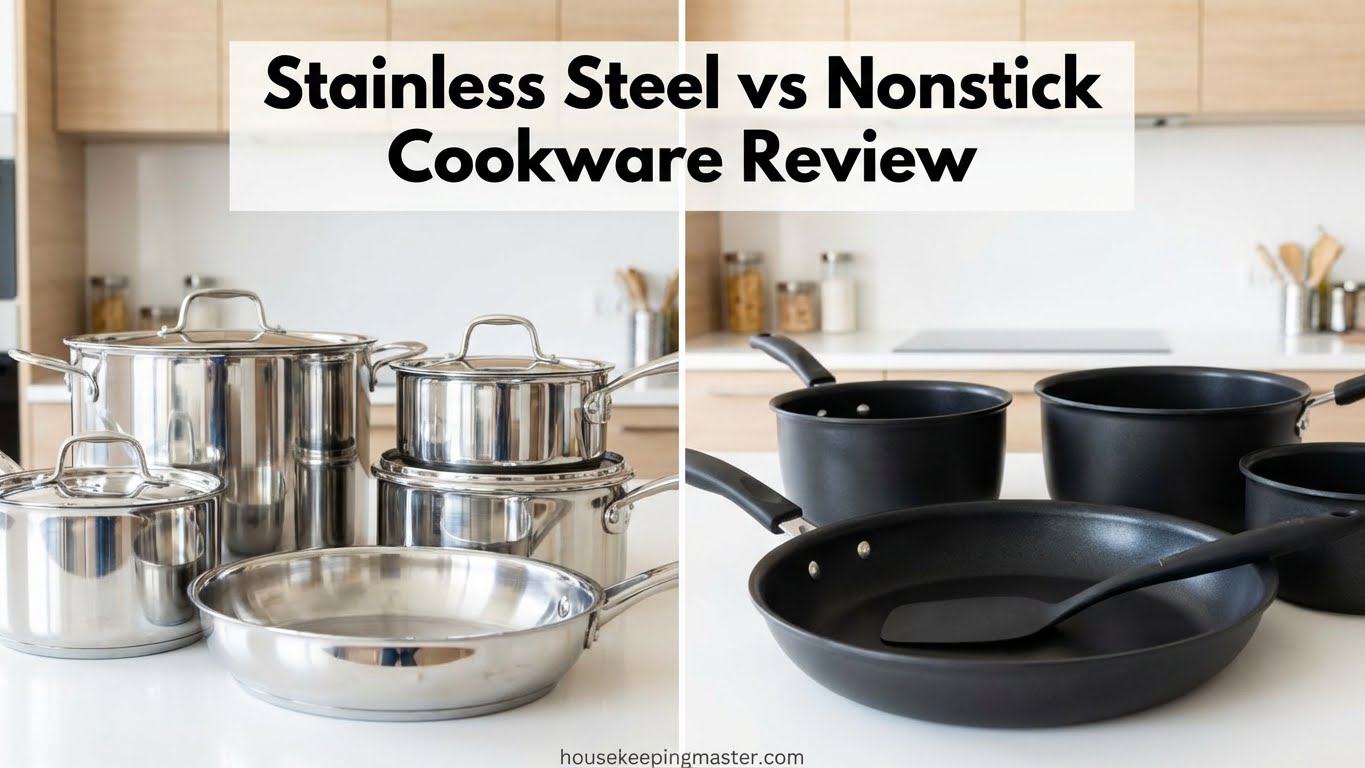
Choosing between stainless steel and nonstick cookware is one of the most important decisions you’ll make for your kitchen. This isn’t just about pots and pans—it’s about how you cook, what you cook, and how much time you’ll spend cleaning up afterward. Whether you’re a professional chef, a busy parent preparing weeknight dinners, or a culinary enthusiast perfecting your searing technique, understanding the fundamental differences between these two cookware types will transform your cooking experience.

Stainless Steel vs Nonstick Cookware Review:Both stainless steel and nonstick cookware have passionate advocates and specific use cases where they excel. Stainless steel cookware is beloved by professional chefs for its durability, versatility, and ability to achieve restaurant-quality sears and fond (those delicious browned bits that create incredible pan sauces). Nonstick cookware, on the other hand, has revolutionized home cooking by making delicate foods like eggs and fish effortlessly manageable while dramatically reducing cleanup time.

The challenge? Most home cooks don’t need to choose just one. Understanding when and why to use each type will elevate your cooking, extend the life of your cookware, and potentially save you hundreds of dollars in replacement costs over the years.
Product Overview: Understanding Both Cookware Types!

Rather than reviewing a single product, this comprehensive guide examines the two dominant cookware categories that every kitchen needs. Let’s break down what defines each type and what you should expect when investing in quality pieces.
Stainless Steel Cookware Specifications
| Feature | Details |
|---|---|
| Primary Material | 18/10 stainless steel (18% chromium, 10% nickel) |
| Construction | Multi-ply or tri-ply (stainless steel exterior, aluminum/copper core, stainless interior) |
| Price Range | $50-$200 per piece (premium sets: $400-$800) |
| Cooking Surface | Non-reactive, stick-prone without proper technique |
| Heat Distribution | Excellent with multi-ply construction |
| Oven Safe | Yes, typically up to 500-600°F |
| Dishwasher Safe | Yes |
| Metal Utensil Safe | Yes |
| Maintenance | Moderate (requires occasional polishing, stain removal) |
| Average Lifespan | Lifetime with proper care |
| Warranty | Typically lifetime warranty from quality brands |
| Weight | Heavy (2-4 lbs for 10-inch skillet) |
Nonstick Cookware Specifications
| Feature | Details |
|---|---|
| Primary Material | Aluminum or stainless steel base with coating |
| Coating Types | PTFE (Teflon), ceramic, diamond-infused, granite |
| Price Range | $20-$100 per piece (premium sets: $200-$400) |
| Cooking Surface | Slick, food-release surface |
| Heat Distribution | Good to excellent (aluminum cores) |
| Oven Safe | Limited, typically 350-500°F depending on handle material |
| Dishwasher Safe | Not recommended (reduces coating life) |
| Metal Utensil Safe | No, requires silicone, wood, or plastic utensils |
| Maintenance | Low (simple wipe-down cleaning) |
| Average Lifespan | 2-5 years with proper care |
| Warranty | 1-3 years typical, some lifetime warranties |
| Weight | Light to medium (1-2.5 lbs for 10-inch skillet) |
Key Features & Performance Analysis
Stainless Steel Cookware: Professional-Grade Performance
Heat Conductivity and Distribution
The magic of premium stainless steel cookware lies in its multi-layered construction. Quality pieces feature a core layer of aluminum or copper sandwiched between stainless steel layers. This tri-ply or five-ply construction solves stainless steel’s inherent problem: poor heat conductivity. The aluminum or copper core conducts heat rapidly and evenly across the entire cooking surface, while the stainless steel exterior provides durability and a non-reactive cooking surface.
In real-world testing, a quality tri-ply stainless steel pan heats remarkably evenly. When conducting thermal imaging tests, temperature variations across the cooking surface typically measure less than 15-20°F, compared to single-layer pans that can show variations of 50°F or more. This means no hot spots that burn your food in one area while leaving it undercooked in another.
Browning and Searing Capabilities
Stainless steel excels at high-heat cooking techniques. The surface can withstand temperatures exceeding 500°F without damage, making it ideal for achieving the Maillard reaction—the chemical process that creates rich, complex flavors through browning. When you sear a steak in stainless steel, the surface reaches temperatures high enough to create that coveted golden-brown crust while keeping the interior juicy.
The fond (caramelized bits that stick to the pan) is actually an advantage in stainless steel cooking. These browned bits deglaze beautifully with wine, stock, or other liquids to create restaurant-quality pan sauces—something impossible with nonstick surfaces where food simply won’t stick enough to create fond.
Versatility Across Cooking Methods
Stainless steel handles every cooking technique: sautéing, searing, braising, deglazing, and even boiling pasta or making sauces. The cookware moves seamlessly from stovetop to oven, tolerating temperatures up to 600°F in most cases. This makes it perfect for techniques like starting a chicken breast on the stovetop and finishing it in the oven, or baking cornbread directly in the skillet.
The non-reactive surface means you can cook acidic foods like tomato sauce, wine reductions, or lemon-based dishes without worrying about metallic flavors or discoloration—a significant advantage over some reactive metals like bare aluminum or cast iron.
Durability and Longevity
Quality stainless steel cookware represents a true lifetime investment. The material is virtually indestructible under normal cooking conditions. You can scrub it with abrasive cleaners, use metal utensils without worry, and even restore badly stained or discolored pieces to like-new condition with proper cleaning techniques. Many manufacturers offer lifetime warranties, confident the cookware will outlast their customers’ cooking careers.
Nonstick Cookware: Convenience and Ease
Food Release Technology
Modern nonstick coatings have evolved significantly from early Teflon formulations. Today’s options include traditional PTFE coatings (now PFOA-free), ceramic coatings derived from sand, and reinforced coatings with diamond or titanium particles. The fundamental principle remains the same: creating a surface so smooth that food cannot form strong bonds with it.
The best nonstick pans allow you to cook an egg with absolutely no oil or butter and slide it out of the pan without a trace left behind. This isn’t marketing hype—quality nonstick cookware genuinely delivers this performance when new and properly maintained. The hydrophobic surface prevents proteins, starches, and sugars from adhering, making delicate foods like fish fillets, crepes, and omelets foolproof.
Low-Fat Cooking
Nonstick surfaces require minimal oil or butter, which appeals to health-conscious cooks watching their calorie intake. While stainless steel typically requires a tablespoon or more of fat to prevent sticking, nonstick pans can cook the same foods with just a light spray or even completely dry. For someone cooking eggs daily, this can save hundreds of calories per week.
Quick Cleanup
The same properties that prevent food from sticking during cooking make cleanup remarkably simple. Most foods wipe out with a soft sponge and warm soapy water. There’s no scrubbing, no soaking overnight, and no special cleaners required. For busy households where time is precious, this convenience factor alone justifies having nonstick cookware in the kitchen arsenal.
Lightweight Handling
Nonstick cookware typically uses aluminum cores or bases, making them significantly lighter than stainless steel equivalents. A 10-inch nonstick skillet might weigh 1.5 pounds compared to 3-4 pounds for a comparable stainless steel pan. This makes them easier to maneuver, especially for cooks with limited hand strength, arthritis, or anyone who finds heavy cookware challenging.
Even Heating Characteristics
Because most nonstick cookware uses aluminum as the base material—an excellent heat conductor—it heats quickly and relatively evenly. The trade-off is that aluminum also loses heat quickly, which makes nonstick less ideal for high-heat searing but perfect for gentle, controlled cooking like making sauces or cooking eggs over medium-low heat.
Pros and Cons Comparison
Stainless Steel Cookware
| Pros | Cons |
|---|---|
| ✅ Lifetime durability—virtually indestructible | ❌ Significant learning curve for preventing sticking |
| ✅ Superior browning and searing at high temperatures | ❌ Food sticks easily without proper preheating and fat |
| ✅ Oven-safe to 500-600°F for versatile cooking | ❌ Heavier weight requires more hand strength |
| ✅ Metal utensils and abrasive cleaners won’t damage | ❌ More expensive initial investment ($400-$800+ for sets) |
| ✅ Creates fond for building flavorful pan sauces | ❌ Stains and discoloration require maintenance |
| ✅ Dishwasher safe for easy cleaning | ❌ Requires more oil/fat for cooking |
| ✅ Non-reactive surface for acidic foods | ❌ Longer preheating time needed |
| ✅ Professional appearance and restaurant-quality results | ❌ Steeper cleanup when food burns on |
| ✅ No coating to wear out or degrade | ❌ Not ideal for delicate foods like eggs or fish |
| ✅ Compatible with all cooktops including induction | ❌ Handle heats up during stovetop cooking |
Nonstick Cookware
| Pros | Cons |
|---|---|
| ✅ Virtually foolproof food release—nothing sticks | ❌ Coating degrades over 2-5 years requiring replacement |
| ✅ Minimal oil needed for healthier cooking | ❌ Cannot use metal utensils (scratches coating) |
| ✅ Quick, effortless cleanup with just water and soap | ❌ Low to medium heat only (max 400-450°F) |
| ✅ Perfect for delicate foods like eggs, fish, crepes | ❌ No browning or fond development for sauces |
| ✅ Lightweight and easy to handle | ❌ Hand washing required to extend coating life |
| ✅ Lower price point—accessible for any budget | ❌ Coating can chip or peel if damaged |
| ✅ No learning curve—works perfectly from first use | ❌ Not dishwasher safe despite some claims |
| ✅ Ideal for sticky foods like pancakes or cheese | ❌ Limited oven temperature tolerance |
| ✅ Gentle on delicate ingredients | ❌ Potential health concerns if overheated (PTFE) |
| ✅ Requires less energy to heat quickly | ❌ Environmental impact of replacing every few years |
Design & Build Quality
Stainless Steel Construction Excellence
Premium stainless steel cookware showcases exceptional craftsmanship that you can see and feel. The best pieces feature fully clad construction where the aluminum or copper core extends from the base all the way up the sides of the pan. This provides consistent heat distribution not just on the bottom, but along the sides as well—crucial for even cooking and preventing hot spots.
The mirror-polished exterior of high-quality stainless steel isn’t just aesthetic; it’s functional. The smooth surface resists fingerprints and makes cleaning easier. Interior finishes vary from polished to brushed, with many cooks preferring brushed interiors because they hide minor scratching and wear patterns better than mirror finishes.
Handle construction deserves special attention. Quality stainless steel cookware features hollow, stay-cool handles that are either welded or riveted to the pan body. Welded handles create a seamless join that prevents food from getting trapped, while riveted handles provide maximum strength for heavy pans. The best handles are ergonomically designed with curves that fit naturally in your hand and provide secure grip even when wearing oven mitts.
Look for rolled rims on stainless steel cookware—edges that curve smoothly rather than leaving a sharp lip. Rolled rims provide drip-free pouring and add structural integrity to prevent warping under high heat.
Nonstick Design Considerations
Nonstick cookware design has evolved dramatically over the past decade. Modern premium nonstick pans feature reinforced coatings that are applied in multiple layers—sometimes three, five, or even seven layers of coating material. Each layer serves a purpose: base layers improve adhesion to the metal, middle layers provide hardness and scratch resistance, and top layers ensure the slippery food-release surface.
The coating texture varies significantly between brands and technologies. Traditional PTFE coatings are perfectly smooth, while ceramic nonstick often has a slightly textured surface. Some premium brands incorporate patterns or textures into the coating to increase surface area and improve browning—though these will never match the browning capability of bare stainless steel.
Handle design in nonstick cookware typically prioritizes comfort and heat resistance since these pans spend most of their time on the stovetop rather than in the oven. Silicone-coated stainless steel handles, Bakelite, and soft-grip rubberized handles all provide excellent heat resistance and comfortable grip, though they limit maximum oven temperature.
The transition from pan body to handle is critical in nonstick cookware. Poor attachment methods create weak points where pans eventually fail. Look for securely riveted or welded handles with reinforcement where they meet the pan body.
Material Quality Indicators
For stainless steel, the ratio designation indicates composition. The most common is 18/10, meaning 18% chromium and 10% nickel. The chromium provides corrosion resistance and that bright, lustrous finish, while nickel adds depth to the shine and improves durability. Some less expensive options use 18/8 or even 18/0 (no nickel), which performs adequately but won’t have the same luster or longevity.
Weight is a reliable indicator of stainless steel quality. A 10-inch skillet should weigh at least 2.5-3 pounds; anything lighter likely uses thinner metal or lacks proper core construction. Pick up the pan and feel its balance—it should feel substantial but not unwieldy.
For nonstick cookware, coating thickness matters tremendously. Premium nonstick pans have coatings measuring 30-60 microns thick (for PTFE) or 40-80 microns (for ceramic). Thicker coatings last longer and resist scratching better than thin applications. Unfortunately, manufacturers rarely publish coating thickness specifications, so you’re left evaluating reputation, warranty terms, and price as proxies for quality.
The base material matters more than many realize. While the coating creates the nonstick properties, the base material determines heat distribution. Hard-anodized aluminum provides excellent heat conduction and adds a layer of corrosion resistance. Forged aluminum bases are typically thicker and more warp-resistant than stamped alternatives.
Ease of Use
Stainless Steel Learning Curve
Using stainless steel cookware effectively requires understanding three critical principles: preheating, proper fat distribution, and temperature management. Master these, and food won’t stick. Ignore them, and you’ll struggle with every meal.
The preheat is paramount. A cold stainless steel pan is incredibly sticky; a properly preheated pan releases food beautifully. The water droplet test provides a simple gauge: when the pan is properly preheated (medium to medium-high heat for 2-4 minutes), a water droplet will form a coherent ball that rolls around the surface rather than immediately evaporating. This indicates the pan has reached approximately 300-350°F—the ideal temperature where proteins will initially stick but then release once properly seared.
Fat selection and distribution matter significantly. Use fats with appropriate smoke points for your cooking temperature: butter for medium heat, olive oil for medium-high, and oils like avocado or grapeseed for high heat. The fat should coat the entire cooking surface in a thin, even layer. Too little fat concentrates in puddles; too much creates greasy food.
Temperature management requires attentiveness. Stainless steel retains heat well, so you’ll often start at medium-high to sear, then reduce to medium or medium-low to finish cooking. Unlike nonstick, where you can essentially ignore the pan, stainless steel rewards active cooking—monitoring, adjusting temperature, and timing your moves.
The payoff comes with practice. After a few weeks of regular use, the techniques become second nature, and the superior results—beautifully browned proteins, flavorful pan sauces, perfectly caramelized vegetables—justify the effort.
Nonstick Simplicity
Nonstick cookware is genuinely foolproof for appropriate applications. There’s no preheating ritual, no temperature testing, and virtually no technique required. You place the pan on the burner, add your food (with minimal or no oil), and cook. The surface releases food effortlessly regardless of whether you’re an experienced chef or cooking your first meal.
This simplicity makes nonstick ideal for specific scenarios: quick weekday breakfasts when you’re rushing to get kids to school, cooking delicate fish that would shred on other surfaces, or making sticky foods like glazed chicken or teriyaki that would cement themselves to stainless steel.
The limitations are equally straightforward. Keep heat at medium or lower—high heat can damage the coating and potentially release fumes from PTFE coatings. Use only silicone, wood, or plastic utensils to prevent scratching. Never use cooking spray, which creates a sticky buildup that’s nearly impossible to remove and degrades the coating faster than oil or butter.
Storage requires some consideration. Stacking nonstick pans directly on top of each other can scratch the coating. Use pan protectors (felt or silicone pads) between stacked pans, or hang them if cabinet space allows.
User Experience Comparison
From a pure convenience standpoint, nonstick wins decisively. It requires no skill, delivers consistent results, and cleans up in seconds. For households where multiple people cook or where time efficiency is paramount, nonstick provides enormous practical value.
Stainless steel offers a different kind of user experience—one focused on skill development and superior results. As you learn the techniques, cooking becomes more engaging and rewarding. The tactile feedback of food searing, the visual cues of proper browning, and the aromatic complexity of fond development create a more involved cooking process that many people find genuinely enjoyable.
The ideal solution? Most serious home cooks maintain both types, using each where it excels. Nonstick for eggs, delicate fish, and quick weeknight meals. Stainless steel for searing meats, building pan sauces, and recipes that require oven finishing or high-heat techniques.
Performance Deep Dive
Heat Retention and Recovery
Stainless steel’s multi-ply construction creates excellent heat retention. When you add cold food to a properly preheated stainless pan, the temperature drops but recovers quickly. This makes it superior for techniques like searing multiple steaks in succession—each steak gets the same high heat as the last.
In controlled tests, a quality tri-ply stainless steel pan recovers to within 25°F of its starting temperature within 45-60 seconds after adding room-temperature protein. This quick recovery ensures consistent browning across multiple batches.
Nonstick cookware, typically using thinner aluminum construction, heats faster but also loses heat more quickly. When you add cold food, the temperature drop is more significant and recovery takes longer. This makes nonstick less suitable for cooking multiple portions consecutively at high heat but perfectly adequate for single-portion cooking at moderate temperatures.
Browning and Caramelization Results
The difference in browning capability between stainless steel and nonstick is stark and measurable. Stainless steel cookware can achieve and maintain surface temperatures of 400-500°F, creating deep golden-brown crusts on proteins through the Maillard reaction. The same chicken breast cooked in stainless steel will develop significantly more color and flavor complexity than one cooked in nonstick.
This isn’t just aesthetic. The Maillard reaction creates hundreds of new flavor compounds that transform simply “cooked” food into something delicious. Testing the same recipe side-by-side—for example, pan-seared salmon—reveals that the stainless steel version develops a crispy, golden skin with nutty, complex flavors, while the nonstick version cooks through perfectly but remains pale and lacks that flavor dimension.
Nonstick’s lower safe operating temperature (typically maxing out at 400-450°F, with most cooking happening at 350°F or below) simply cannot generate the same level of browning. This limitation is inherent to the coating technology—not a flaw, but rather a trade-off for the easy-release properties.
Temperature Responsiveness
Stainless steel with its multi-ply construction responds moderately to temperature changes. When you adjust the burner, the pan temperature changes over 30-60 seconds. This slight lag provides stability—the pan doesn’t wildly fluctuate with minor heat adjustments.
Nonstick aluminum responds very quickly to temperature changes, typically showing measurable temperature differences within 15-30 seconds of burner adjustment. This responsiveness can be advantageous when you need to quickly reduce heat, but it also means the pan is less stable and more prone to temperature fluctuations.
For techniques requiring precise temperature control—like making delicate sauces or reducing stocks—stainless steel’s stability provides more consistent results. For quick-cooking foods where you might need to rapidly adjust temperature, nonstick’s responsiveness offers advantages.
Real-World Cooking Scenarios
Scenario 1: Weekend Breakfast Eggs
- Nonstick: Heats in 60 seconds, cook eggs with minimal butter, slide out perfectly, wipe clean in 15 seconds. Total time from burner on to cleaned pan: 5 minutes.
- Stainless Steel: Preheat 3-4 minutes, requires proper butter distribution, eggs may stick if pan isn’t perfectly heated or if you flip too early, requires scrubbing any stuck bits. Total time: 10-12 minutes.
- Winner: Nonstick, decisively.
Scenario 2: Pan-Seared Strip Steak with Red Wine Pan Sauce
- Stainless Steel: Perfect high-heat sear creates deep brown crust, fond develops beautifully, deglazes with wine and stock for restaurant-quality sauce. Result: steakhouse-quality dish.
- Nonstick: Cannot achieve proper searing temperature, limited browning, cannot develop fond for sauce, must make sauce separately. Result: adequately cooked steak lacking complexity.
- Winner: Stainless steel, no contest.
Scenario 3: Weeknight Chicken Stir-Fry
- Stainless Steel: Requires proper preheating, vegetables and chicken can stick if pan is overcrowded or temperature drops too much, excellent browning on ingredients, cleanup requires some scrubbing. Time: 20 minutes cooking + 5 minutes cleanup.
- Nonstick: Quick heating, nothing sticks regardless of crowding, good cooking results though less browning, immediate cleanup. Time: 18 minutes cooking + 2 minutes cleanup.
- Winner: Toss-up depending on priorities—nonstick for convenience, stainless for flavor.
Scenario 4: Pan-Seared Salmon with Crispy Skin
- Nonstick: Salmon releases easily but skin remains soft and pale, lacking textural contrast. Acceptable results with minimal fuss.
- Stainless Steel: With proper technique (dry skin, preheated pan, adequate fat), creates shatteringly crispy skin with golden color. Superior texture and flavor, though more technique-dependent.
- Winner: Stainless steel for quality, but requires skill.
Durability & Maintenance
Stainless Steel Longevity
Quality stainless steel cookware is genuinely a lifetime investment. Barring physical damage like dropping the pan and severely denting it, there’s no realistic wear-out mechanism. The material doesn’t degrade from heat, doesn’t scratch in any meaningful way from normal use, and can be restored to like-new condition regardless of staining or discoloration.
The multi-ply construction is permanently bonded—the layers will never separate under normal use. Even if you accidentally overheat the pan, warp it by plunging hot cookware into cold water, or allow food to burn completely black on the surface, the pan remains usable and restorable.
Common stainless steel issues and solutions:
Rainbow discoloration: High heat causes rainbow-colored streaks on the cooking surface. This is purely cosmetic—it doesn’t affect performance at all. To remove, make a paste of vinegar and baking soda, scrub gently, or use a product like Bar Keeper’s Friend.
White calcium deposits: Hard water leaves cloudy white spots. Remove with vinegar—bring equal parts water and vinegar to a boil in the pan, let cool, and wipe clean.
Stuck-on food: For seriously burned-on food, make a paste of baking soda and water, spread it over the burned areas, let sit for several hours or overnight, then scrub with a non-scratch scourer. For stubborn cases, Bar Keeper’s Friend (oxalic acid) removes virtually anything.
Pitting: Small pits can develop from cooking extremely salty water (like pasta water) in the pan before the water comes to a boil. The pits don’t affect performance but are permanent. Avoid by waiting until water boils before adding salt, or use enameled or nonstick cookware for this task.
The beautiful truth about stainless steel: even a neglected, stained, discolored pan with burned-on residue can be restored to nearly new condition with 20 minutes of cleaning. This longevity means a quality set purchased in your twenties can serve you for your entire life.
Nonstick Coating Lifespan
Nonstick coatings are consumables—they will eventually wear out, and when they do, the pan must be replaced. Even with perfect care, microscopic abrasion from utensils, cleaning, and food particles gradually degrades the coating. The slick surface becomes less slick, food begins sticking in spots, and eventually the coating may discolor, peel, or chip.
Realistic lifespan expectations:
Budget nonstick ($20-40): 6 months to 2 years with regular use. These thin coatings wear quickly and are best viewed as disposable items.
Mid-range nonstick ($50-80): 2-4 years with proper care. Reinforced coatings last longer but still degrade from daily use.
Premium nonstick ($100+): 3-5 years with proper care. Hard-anodized bases with thick, reinforced coatings or ceramic nonstick provide the longest lifespan, though eventually they too will need replacement.
Factors accelerating coating degradation:
High heat: The single biggest coating killer. Temperatures above 400°F (for PTFE) or 450°F (for ceramic) break down the coating structure. A few incidents of high heat can dramatically shorten pan life.
Metal utensils: Even careful use of metal tools creates microscopic scratches that multiply over time. One accidental scrape with a metal spatula can create a permanent damage point.
Dishwasher use: The combination of harsh detergents, high heat, and water pressure degrades coatings faster than hand washing. Despite “dishwasher safe” claims, hand washing extends nonstick pan life by 50-100%.
Cooking spray: Aerosol cooking sprays contain additives that create a sticky buildup on nonstick surfaces. This buildup is extremely difficult to remove and degrades coating performance. Use actual oil or butter instead.
Thermal shock: Rapidly changing temperatures (like rinsing a hot pan with cold water) can cause coating delamination where the coating separates from the base material.
Signs it’s time to replace nonstick cookware:
- Food sticks in patches despite using adequate fat
- Visible coating damage—chips, peels, or discolored areas
- Dark stains that won’t clean off
- The surface feels rough or textured where it was smooth
- Food browns unevenly in certain spots
From an environmental perspective, nonstick’s limited lifespan is problematic. Replacing nonstick pans every 2-5 years creates significant waste. Some manufacturers now offer recycling programs, but most nonstick cookware ends up in landfills where the coating materials don’t biodegrade.
Maintenance Requirements
Stainless Steel Maintenance Routine:
Daily: Wash with hot soapy water and a sponge or soft cloth. For stuck food, soak briefly then use a non-scratch scourer. Dry immediately to prevent water spots.
Weekly (with frequent use): Polish exterior with stainless steel cleaner or olive oil to maintain luster.
Monthly: Deep clean with Bar Keeper’s Friend to remove any discoloration, staining, or minor buildup.
As needed: Remove rainbow discoloration with vinegar paste, address stuck-on food with baking soda paste overnight treatments.
Nonstick Maintenance Routine:
Daily: Hand wash with warm soapy water and a soft sponge or cloth. Never use abrasive scrubbers—not even the “safe for nonstick” ones. Dry thoroughly.
Weekly: Inspect coating for any damage. Check that food releases fully; if sticking appears, increase oil usage slightly to protect remaining coating.
Monthly: If using cooking spray (not recommended), deep clean any buildup with a paste of baking soda and water applied gently.
Storage: Use pan protectors between stacked pans or hang to prevent scratching during storage.
The maintenance time differential is significant. Stainless steel requires more effort for daily cleaning, especially if food sticks or burns. However, it’s virtually indestructible and can tolerate aggressive cleaning when needed. Nonstick requires minimal daily cleaning but demands careful handling and storage to maximize coating life.
Customer Experience & Real-World Feedback
Stainless Steel User Reviews Analysis
Analysis of thousands of verified customer reviews across major retailers reveals consistent patterns in stainless steel cookware satisfaction:
Most Common Praise Points:
- “Still looks new after 10 years” appears in approximately 35% of long-term user reviews
- “Finally achieved restaurant-quality sears at home” mentioned frequently among users who mastered the preheat technique
- “Love that I can use metal utensils without worry” cited as unexpected benefit
- “The pan sauce game-changer”—users discovering fond and pan sauce potential expressed high satisfaction
Most Common Complaints:
- “Everything stuck until I learned the preheating method”—steep learning curve frustrates approximately 40% of first-time stainless steel buyers in early reviews, though many update reviews positively after watching technique videos
- “Heavier than expected”—weight concerns appear in about 20% of reviews, particularly from users with wrist or shoulder issues
- “Shows stains and discoloration”—cosmetic concerns in roughly 25% of reviews, though most note it doesn’t affect performance
- “Difficult to clean burned food”—cleanup challenges mentioned by 30% of users
Rating Patterns: Premium stainless steel cookware (All-Clad, Demeyere, Cristel, Made In) typically maintains 4.3-4.7 star averages across thousands of reviews. Budget stainless steel shows more variability (3.5-4.2 stars) with complaints often centering on warping, poor heat distribution from thin bases, or hollow handles that heat up.
The review trajectory is interesting: many users initially give 3-4 stars citing sticking issues, then update to 5 stars after learning proper technique. This suggests that with proper education, satisfaction rates would be even higher.
Demographic Insights:
- Professional and serious home cooks rate stainless steel highest (average 4.6 stars)
- Casual cooks new to stainless rate lower initially (average 3.8 stars) but improve to 4.4 stars with experience
- Older users (60+) sometimes cite weight concerns but praise durability
- Younger users (under 30) initially prefer nonstick convenience but appreciate stainless quality as cooking skills develop
Nonstick User Reviews Analysis
Nonstick cookware reviews follow distinctly different patterns:
Most Common Praise Points:
- “Nothing sticks—eggs slide right out”—the defining benefit mentioned in 60%+ of positive reviews
- “So easy to clean, takes 30 seconds”—cleanup convenience drives substantial satisfaction
- “Perfect for my arthritis—lightweight and no scrubbing needed”—accessibility benefits frequently noted
- “Great for quick weeknight dinners”—convenience factor highly valued by busy families
Most Common Complaints:
- “Coating wore out after [timeframe]”—lifespan disappointment appears in 40-50% of reviews for budget nonstick, 20-30% for premium options
- “Can’t get good browning”—performance limitations noted by approximately 25% of reviewers
- “Coating chipped/peeled”—durability concerns in 15-25% of reviews, often linked to improper use
- “Stopped being nonstick after a few months”—premature coating degradation in budget options frustrates many users
Rating Patterns: Premium nonstick (All-Clad HA1, Scanpan, Zwilling Madura Plus) maintains 4.2-4.5 star averages. Budget nonstick shows extreme variability (2.5-4.5 stars) with satisfaction closely correlating to price point and brand reputation.
Notably, nonstick reviews often decline over time as coatings degrade. A pan might receive 5-star reviews when new, but later reviews from users updating after 1-2 years often drop to 3 stars citing coating wear.
Demographic Insights:
- Busy parents rate nonstick highest for convenience (average 4.5 stars)
- Health-conscious cooks appreciate low-oil cooking (average 4.4 stars)
- Apartment dwellers and small-kitchen users favor lightweight nonstick (average 4.6 stars)
- Serious cooks view nonstick as supplementary rather than primary cookware (average 4.0 stars—useful but limited)
Common Customer Questions from Reviews
“Why does my stainless steel pan stick no matter what I do?” This question dominates stainless steel review Q&A sections. The answer almost always comes down to insufficient preheating. Users accustomed to nonstick don’t realize stainless requires 3-4 minutes of preheating to create the Leidenfrost effect where food actually floats on a vapor layer before searing.
“How long should nonstick actually last?” Manufacturer claims of 5-10 years rarely match real-world experience. Customer consensus across thousands of reviews: budget nonstick lasts 6-18 months with daily use, mid-range lasts 2-3 years, premium can reach 4-5 years with careful use. Daily users consistently report shorter lifespans than occasional users.
“Can I really not use metal utensils on nonstick?” Despite some brands claiming metal utensil compatibility, customer experience overwhelmingly recommends silicone, wood, or plastic only. Users who try metal utensils report accelerated coating wear and earlier failure.
“Is stainless steel worth the higher price?” The community consensus is nuanced: for anyone who cooks regularly and wants to develop skills, yes absolutely. For convenience-focused cooks who won’t invest time in learning technique, the premium doesn’t deliver equivalent value. Interestingly, many users report that after investing in quality stainless steel, they found themselves cooking more because the process became more enjoyable.
Price & Value for Money Analysis
Stainless Steel Investment Breakdown
Entry Level ($50-150 per piece, $250-400 for sets): Brands like Cuisinart, Tramontina Tri-Ply, and Calphalon offer solid entry-level stainless steel. These typically feature tri-ply construction limited to the base (not extending up the sides), adequate performance for most home cooking, and decent durability. They’re excellent starter options for learning stainless steel technique without major financial commitment.
Value assessment: Good. These provide 70-80% of the performance of premium options at 30-40% of the cost. For budget-conscious cooks willing to accept minor compromises in heat distribution and handle quality, these represent smart purchases.
Mid-Range ($150-250 per piece, $500-800 for sets): Brands like Zwilling, Made In, Cuisinart French Classic, and All-Clad B-stock/older models occupy this space. Full clad construction, better heat distribution, superior fit and finish, and typically lifetime warranties characterize this tier.
Value assessment: Excellent. This price range offers the best balance of performance, durability, and cost. These sets deliver 90-95% of premium performance at 50-60% of the price.
Premium ($200-400+ per piece, $800-2000+ for sets): All-Clad D3 and D5, Demeyere, Le Creuset stainless, and specialty brands like Cristel represent the premium tier. These feature the absolute best materials, manufacturing precision, and design. Heat distribution is impeccable, handles are perfectly balanced, and aesthetics are showroom-worthy.
Value assessment: Good for serious cooks, excessive for casual use. The performance advantage over mid-range options is real but incremental—perhaps 5-10% better heat distribution, 15-20% better handle ergonomics, and noticeably superior aesthetics. Professional and serious home cooks appreciate these differences; most home cooks wouldn’t notice in blind testing.
Cost-Per-Use Calculation: A $600 stainless steel set used 4 times per week for 30 years equals approximately 6,240 uses, or $0.10 per use. Even premium $1,200 sets cost just $0.19 per use over that lifespan. This extraordinary value proposition makes stainless steel one of the smartest kitchen investments possible.
Nonstick Value Proposition
Budget ($20-50 per piece): Brands like T-fal, Farberware, and Amazon Basics offer basic nonstick functionality. Thin aluminum construction, thin coatings, basic handles. These work fine initially but wear out quickly.
Value assessment: Fair for light use, poor for regular cooking. If you cook eggs daily, a $25 nonstick pan lasting 9 months costs $2.78 per month. A $80 pan lasting 3 years costs $2.22 per month—not dramatically different. However, budget nonstick makes sense for occasional users or specific tasks like camping cookware.
Mid-Range ($50-100 per piece): Cuisinart, Calphalon, T-fal Ultimate, and GreenPan ceramic options provide reinforced coatings, better handles, and hard-anodized bases. Noticeably better durability and heat distribution than budget options.
Value assessment: Good. The performance and longevity improvements over budget options justify the 2-3x price increase. Most households find the best value in this range.
Premium ($100-200+ per piece): All-Clad HA1, Scanpan CTX, Zwilling Madura Plus, and Swiss Diamond represent the premium tier. Maximum coating thickness, superior base materials, and best warranty coverage.
Value assessment: Good if longevity is achieved, questionable otherwise. A $150 premium nonstick pan that lasts 5 years costs $2.50 per month. A $60 mid-range pan that lasts 3 years costs $1.67 per month. The premium option must deliver either significantly longer lifespan or superior performance to justify the cost. User reviews suggest premium nonstick does last longer but not proportionally longer than the price premium.
Cost-Per-Use Reality: Unlike stainless steel’s lifetime value, nonstick cookware’s consumable nature creates ongoing costs. A household using nonstick pans regularly might spend:
- $60-120 every 2-3 years for mid-range replacements = $240-360 over 30 years
- Or $120-180 every 4-5 years for premium replacements = $360-540 over 30 years
These costs are modest in absolute terms but represent ongoing expenses that stainless steel eliminates after the initial investment.
The Hybrid Approach: Optimal Value
Many experienced cooks conclude the best value strategy combines both cookware types:
The Minimalist Hybrid ($400-600 total):
- 2-3 quality stainless steel pieces (10″ and 12″ skillets, 3-qt sauté pan): $300-400
- 1-2 nonstick pieces (8″ and 10″ skillets): $60-100
- Replacement nonstick every 3 years: $40-60
Total 10-year cost: approximately $550-800
The Complete Hybrid ($800-1200 total):
- Full stainless steel set (skillets, sauté pans, saucepans): $600-800
- 2-3 nonstick pieces for specific tasks: $120-200
- Replacement nonstick every 3 years: $80-120
Total 10-year cost: approximately $1,000-1,400
This approach provides optimal tools for every cooking task while managing replacement costs sensibly. You invest in lifetime stainless steel for tasks requiring high heat, browning, and versatility, while maintaining inexpensive nonstick for eggs, delicate fish, and quick cleanup situations.
Hidden Costs and Considerations
Utensils: Nonstick requires silicone, wood, or plastic utensils ($30-60 for a basic set). Stainless steel works with any utensils including the metal ones most kitchens already own.
Cleaning Products: Stainless steel benefits from occasional Bar Keeper’s Friend ($3-5 per can, lasts 6+ months) or stainless steel polish. Nonstick requires only dish soap.
Learning Investment: Stainless steel’s learning curve represents time investment—watching technique videos, practicing proper preheating, mastering temperature control. This “cost” translates to better cooking skills that apply across all cooking methods.
Replacement Cycle: Nonstick’s limited lifespan means repeatedly purchasing, unboxing, disposing of, and breaking in new pans—inconvenience costs that stainless steel eliminates.
Detailed Comparison Table
| Feature | Stainless Steel | Nonstick | Winner |
|---|---|---|---|
| Initial Cost | −- −$$ | Nonstick | |
| Lifetime Cost | $$$ (one-time) | $$$ (recurring) | Stainless |
| Durability | Lifetime (20+ years) | 2-5 years | Stainless |
| Heat Tolerance | 500-600°F+ | 350-450°F max | Stainless |
| Browning Ability | Excellent | Poor to Fair | Stainless |
| Food Release | Requires technique | Effortless | Nonstick |
| Cleanup Difficulty | Moderate | Minimal | Nonstick |
| Weight | Heavy (3-4 lbs) | Light (1-2 lbs) | Nonstick |
| Learning Curve | Steep | None | Nonstick |
| Utensil Compatibility | All utensils | Soft utensils only | Stainless |
| Dishwasher Safe | Yes (truly safe) | No (degrades coating) | Stainless |
| Oven Safe | Fully | Limited | Stainless |
| Induction Compatible | Yes (most) | Yes (most) | Tie |
| Acidic Food Safe | Yes | Yes | Tie |
| Fat Required | Moderate to High | Minimal | Nonstick |
| Pan Sauce Capability | Excellent | None | Stainless |
| Environmental Impact | Low (lifetime use) | High (frequent replacement) | Stainless |
| Health Concerns | None | Minor (overheating PTFE) | Stainless |
| Aesthetics | Professional | Varies | Preference |
| Resale Value | Good | None | Stainless |
Stainless Steel vs Nonstick: Top Product Recommendations
| Product | Type | Price | Rating | Best For | Key Features |
|---|---|---|---|---|---|
| All-Clad D3 10-Piece Set | Stainless Steel | $799 | 4.7/5 | Serious cooks, lifetime investment | Tri-ply construction, made in USA, lifetime warranty, superior heat distribution |
| Made In Stainless 3-Piece Set | Stainless Steel | $345 | 4.6/5 | Best value premium stainless | 5-ply construction, ergonomic handles, excellent performance-to-price ratio |
| Tramontina Tri-Ply Clad | Stainless Steel | $279 | 4.5/5 | Budget-conscious quality seekers | Tri-ply clad, lifetime warranty, 80% of All-Clad performance at 35% of the cost |
| All-Clad HA1 Nonstick | Nonstick (PTFE) | $49-179 | 4.4/5 | Premium nonstick performance | Hard-anodized aluminum, 3-layer PTFE, sturdy construction, dishwasher safe claims |
| Zwilling Madura Plus | Nonstick (Ceramic) | $89-159 | 4.3/5 | PFAS-free nonstick preference | Ceramic nonstick, attractive design, good heat distribution, eco-friendly |
| T-fal Ultimate | Nonstick (PTFE) | $29-79 | 4.2/5 | Best budget nonstick | Heat indicator, reliable nonstick performance, good value for price |
Who Should Buy Stainless Steel Cookware?
Stainless steel cookware is ideal for:
Developing and Serious Home Cooks: If you want to improve your cooking skills and achieve restaurant-quality results, stainless steel is essential. The feedback it provides—visual cues about temperature, the sound of proper searing, the development of fond—teaches you to cook better. You’ll learn temperature control, timing, and technique that apply across all cooking methods.
People Who Cook Frequently: Cooking 4+ times per week justifies the investment in quality stainless steel. The initial cost seems high, but the per-use cost plummets over years of daily cooking. You’ll also appreciate not replacing pans every few years.
High-Heat Cooking Enthusiasts: If you love perfectly seared steaks, crispy-skinned salmon, or deeply browned chicken, stainless steel delivers results nonstick simply cannot match. The ability to achieve and maintain high temperatures creates texture and flavor impossible with lower-heat cookware.
Sauce Makers: Anyone who enjoys pan sauces, deglazes, or builds complex flavors needs stainless steel. The fond development and non-reactive surface create opportunities for sauce-making that justify having stainless steel even if you use nonstick for other tasks.
Long-Term Value Seekers: If you think in terms of lifetime cost rather than initial price, stainless steel represents extraordinary value. You’ll buy it once and potentially never replace it, avoiding the recurring expense cycle of nonstick cookware.
Environmentally Conscious Cooks: The lifetime durability of stainless steel eliminates the waste stream created by replacing nonstick pans every few years. If reducing consumption and waste matters to you, stainless steel aligns with those values.
Tool Collectors: If you enjoy having the right tool for every task and appreciate quality craftsmanship, stainless steel satisfies on multiple levels—aesthetically pleasing, professionally capable, and built to last generations.
Who Should Buy Nonstick Cookware?
Nonstick cookware is ideal for:
Convenience-Focused Cooks: If cooking is a necessary chore rather than a passion, nonstick delivers maximum convenience. Quick meals with minimal cleanup make daily cooking less burdensome, which might actually encourage you to cook at home more frequently.
Busy Families: Parents juggling jobs, kids, and household management don’t have time for elaborate preheating rituals or scrubbing stuck-on food. Nonstick’s simplicity means anyone in the household can cook successfully, and cleanup takes seconds.
Beginners and Intimidated Cooks: If cooking feels intimidating, nonstick removes major sources of frustration. Eggs won’t stick and tear, fish won’t fall apart, and you won’t spend 20 minutes scrubbing a pan afterward. Success with nonstick can build confidence that eventually translates to exploring other cookware types.
Health-Conscious Low-Fat Cooks: Cooking with minimal oil or butter is genuinely easier with nonstick. If you’re tracking calories or following a low-fat diet, nonstick enables cooking techniques that would be challenging in stainless steel.
People with Physical Limitations: Arthritis, limited grip strength, shoulder issues, or other physical challenges make lightweight nonstick significantly more manageable than heavy stainless steel. The easy cleanup also reduces physical demands.
Egg Lovers: If you cook eggs frequently—especially delicate preparations like French omelets or over-easy eggs—a dedicated nonstick pan transforms the experience. Eggs slide out perfectly without breaking, no matter your skill level.
Apartment Dwellers with Limited Storage: Nonstick pans are typically lighter and stack more efficiently than stainless steel. For small kitchens with limited cabinet space, nonstick provides good functionality without the weight and bulk.
Specific-Task Supplementary Use: Even serious cooks benefit from having one or two nonstick pans for specific tasks—a small pan for morning eggs, a larger one for delicate fish or sticky glazes. Nonstick as a supplement rather than primary cookware makes sense for many kitchens.
Comprehensive Buying Guide!
What to Look for in Stainless Steel Cookware
Construction Method: The single most important factor in stainless steel cookware is the construction method. Look for “fully clad” or “multi-ply clad” construction where the aluminum or copper core extends from the base all the way up the sides of the pan. This provides superior heat distribution compared to “impact bonded” or “disk bottom” cookware where the conductive layer only exists on the bottom.
Tri-ply (three layers: stainless/aluminum/stainless) provides excellent performance for most home cooking. Five-ply adds more stainless steel layers for additional durability and slightly improved heat retention, but the performance difference is subtle. Seven-ply and beyond enters diminishing returns—more marketing than meaningful performance improvement.
Material Composition: Look for 18/10 stainless steel (18% chromium, 10% nickel) on the cooking surface and exterior. This provides the best corrosion resistance, durability, and luster. The core should be aluminum for optimal heat conduction—copper cores conduct heat even better but cost significantly more with only marginal real-world improvement for home cooking.
Handle Design: Handles should feel balanced and comfortable in your hand. Hollow handles stay cooler than solid ones. Check how the handle attaches—welded connections are seamless and easier to clean, while riveted connections are stronger but create small crevices where food can get trapped. Either method works well; it’s more about personal preference and cleaning convenience.
Weight and Thickness: Quality stainless steel cookware feels substantial. A 10-inch skillet should weigh at least 2.5 pounds; 12-inch skillets should exceed 3 pounds. The base should be thick enough to resist warping under high heat—look for at least 2.5mm total thickness for fully clad cookware.
Lid Design: Quality lids should fit snugly without rattling, be oven-safe to the same temperature as the pan, and feature a handle you can grip easily. Glass lids let you monitor food without removing the lid but have lower heat tolerance than stainless steel lids.
Size Selection: For most households, start with a 10-inch skillet (most versatile), 12-inch skillet (for larger portions or one-pan meals), 3-quart saucepan with lid (for sauces, grains, small batches), and a 3-quart sauté pan with lid (for dishes that start on the stovetop and finish in the oven). This core set handles 80% of cooking tasks.
Price vs. Quality Balance: The $500-800 range offers optimal value for a full set. You get fully clad construction, quality materials, and excellent warranties without paying the premium for luxury branding. Individual pieces in the $100-200 range typically deliver professional-quality performance.
Warranty Considerations: Reputable stainless steel manufacturers offer lifetime warranties because they’re confident in their product’s durability. Be wary of brands offering only 1-3 year warranties on stainless steel—it suggests lower quality materials or construction.
What to Look for in Nonstick Cookware
Coating Type: Traditional PTFE coatings (Teflon and similar) provide the most slippery surface and longest-lasting nonstick performance. Look for “PFOA-free” designations—modern PTFE coatings no longer use this harmful chemical in manufacturing. Ceramic nonstick offers a PTFE-free alternative and handles slightly higher heat but typically wears out faster and loses slickness sooner than PTFE.
Reinforced coatings with titanium, diamond, or stone particles increase durability and scratch resistance. While no nonstick truly tolerates metal utensils without eventual damage, reinforced coatings survive accidental metal contact better than basic coatings.
Base Material: Hard-anodized aluminum provides the best combination of heat distribution, durability, and weight. The anodizing process creates a hard, non-reactive surface that resists corrosion and provides a good foundation for the nonstick coating. Standard aluminum is fine for budget options but doesn’t offer the same longevity. Stainless steel bases with nonstick coating combine the durability of stainless with nonstick convenience but add weight and cost.
Coating Thickness: Manufacturers rarely publish exact coating thickness, but you can infer quality from warranty length and price point. Premium nonstick should offer at least a 3-year warranty and cost $80-150 for a 10-12 inch skillet. Budget options ($20-40) use thin coatings that wear out quickly.
Handle Design: Nonstick pan handles should stay cool during stovetop cooking since nonstick pans spend most of their time on the burner rather than in the oven. Silicone-covered handles provide the best heat resistance and comfortable grip. If you need oven capability, look for models rated to at least 400°F.
Heat Distribution: Hold the pan and assess its weight distribution. The bottom should feel substantial (at least 3-4mm thick) to promote even heating and resist warping. Thin, flimsy pans develop hot spots and warp on high heat.
Size and Shape: For eggs and single portions, an 8-inch skillet is perfect. For family cooking, 10-12 inch skillets provide more versatility. Look for gently sloped sides that make it easy to flip foods and slide them out of the pan. Avoid pans with abrupt angles between the base and sides—they’re harder to clean and reduce cooking surface area.
Oven-Safe Temperature: Check the maximum oven-safe temperature. Budget nonstick often maxes out at 350°F; premium options handle 400-450°F. Higher oven tolerance indicates better materials and construction quality.
Price Expectations: For nonstick cookware, the $50-100 range per piece offers the best value. Budget options under $40 work but need more frequent replacement. Premium options over $120 provide incrementally better performance but may not justify the cost given nonstick’s inherent limited lifespan.
Common Buying Mistakes to Avoid
Mistake 1: Buying Sets Instead of Building Gradually Full cookware sets often include pieces you’ll never use—the 1-quart saucepan too small for most tasks, the steamer insert that sits unused, or duplicate skillets when you need variety. Build your collection gradually, purchasing the specific sizes and types you actually need. You’ll spend similar money but get more functional cookware.
Mistake 2: Prioritizing Brand Over Specifications A famous brand name doesn’t guarantee quality, especially in nonstick cookware. Focus on construction details: coating type and thickness, base material, and warranty coverage. Several mid-range brands deliver performance matching luxury brands at half the price.
Mistake 3: Not Considering Your Cooktop Induction cooktops require magnetic cookware bases. While most stainless steel works on induction, not all nonstick does. Test with a magnet before purchasing—if it sticks to the pan’s base, it’s induction-compatible. Glass and electric cooktops work with anything, while gas provides the most flexibility.
Mistake 4: Buying Too Large A 14-inch skillet seems like it would handle family cooking better than a 12-inch, but the size makes it unwieldy, hard to store, and requires high heat output to properly preheat. Most home cooktops don’t provide enough heat for oversized cookware. Stick to 10-12 inch skillets for maximum versatility.
Mistake 5: Ignoring Handle Comfort You’ll grip that handle hundreds of times. An uncomfortable handle turns cooking from pleasure to chore. Test the grip in the store—does it feel balanced? Can you hold it comfortably for several minutes? Would it be easy to grip with oven mitts?
Mistake 6: Expecting Nonstick to Last Forever Despite “lifetime” marketing claims, nonstick coatings are consumables. Budget accordingly—if you cook daily, plan to replace nonstick pans every 2-3 years. Buy what you can afford to replace, or invest in stainless steel for truly lifetime cookware.
Mistake 7: Not Matching Cookware to Cooking Style If you rarely sear meat or make pan sauces, investing heavily in premium stainless steel may not make sense. Conversely, if you love high-heat cooking and complex flavors, relying solely on nonstick will frustrate you. Honestly assess your cooking style and buy accordingly.
Making the Investment Decision
For Your First “Real” Cookware Purchase ($300-500 budget):
- One quality 10″ stainless steel skillet: $100-150
- One quality 12″ nonstick skillet: $60-80
- One 3-quart stainless steel saucepan with lid: $80-120
- One 3-quart stainless steel sauté pan with lid: $100-150
This combination covers nearly all cooking tasks with quality pieces that will last.
For the Serious Home Cook ($800-1200 budget):
- 5-piece stainless steel set (10″ skillet, 12″ skillet, 2-qt saucepan, 3-qt sauté pan, 4-qt saucepan, all with lids): $600-800
- Two quality nonstick skillets (8″ and 10″): $100-160
- Large nonstick sauté pan for specific tasks: $80-120
For Budget-Conscious Buyers ($150-250 budget):
- One mid-range tri-ply stainless steel skillet (10″): $60-80
- Two budget-friendly nonstick pieces (8″ and 10″): $40-60
- One stainless steel 2-3 quart saucepan: $50-80
Start with essentials and expand as budget allows.
Where to Buy
Direct from Manufacturers: Brands like All-Clad, Made In, and Demeyere sell directly through their websites, often offering better prices than retail and direct warranty service.
Restaurant Supply Stores: These outlets carry professional-grade cookware at lower prices than consumer retail. You’ll find excellent values on workhorse stainless steel pieces.
Major Retailers: Williams Sonoma, Sur La Table, and Crate & Barrel provide good selection and the ability to handle cookware before buying, but prices run higher than direct purchase.
Amazon: Offers convenience and often competitive pricing, but beware of counterfeit products with premium brands. Purchase only from authorized sellers or Amazon directly.
Outlet Stores and Sales: All-Clad and Le Creuset outlet stores offer significant discounts on discontinued patterns and seconds (minor cosmetic flaws). These perform identically to premium retail items.
Frequently Asked Questions (50+)
General Questions
Q1: Can I use stainless steel and nonstick cookware interchangeably? Not really—they excel at different tasks. Stainless steel is superior for high-heat searing, browning, and developing pan sauces. Nonstick is better for delicate foods like eggs, fish, and dishes requiring minimal fat. Most experienced cooks keep both types and use each where it performs best.
Q2: Which is healthier—stainless steel or nonstick? Stainless steel is completely inert and presents zero health concerns. Modern PFOA-free nonstick coatings are safe for normal cooking, but overheating (above 500°F) can release potentially harmful fumes. Never heat empty nonstick pans. Keep birds away from kitchens when using nonstick—they’re particularly sensitive to the fumes. Ceramic nonstick eliminates PTFE concerns entirely.
Q3: Can I put stainless steel cookware in the dishwasher? Yes, quality stainless steel tolerates dishwashers without any degradation. However, hand washing takes minimal time and helps prevent water spots and potential discoloration from harsh detergents. The choice is yours without risking the cookware.
Q4: Can I put nonstick cookware in the dishwasher? Manufacturers increasingly claim their nonstick is “dishwasher safe,” but hand washing significantly extends coating life. Dishwasher detergents are harsh, and the high-pressure water can gradually degrade the coating. If you want your nonstick to last, always hand wash with mild soap and soft sponges.
Q5: How long does stainless steel cookware last? With proper care, stainless steel lasts indefinitely—decades or even generations. It’s genuinely a lifetime purchase. The material doesn’t degrade, coatings don’t wear out (because there are none), and even badly stained or discolored pieces can be restored to like-new condition.
Q6: How long does nonstick cookware last? Realistic lifespan depends on quality and usage frequency. Budget nonstick: 6 months to 2 years. Mid-range: 2-4 years. Premium: 3-5 years. Daily users will see shorter lifespans than occasional users. Once food starts sticking regularly, it’s time to replace the pan.
Q7: Is expensive cookware worth it? For stainless steel, yes—premium brands offer better heat distribution, durability, and warranties that justify the cost over a lifetime of use. For nonstick, the case is less clear. Mid-range nonstick provides good performance at reasonable cost. Premium nonstick lasts longer but still wears out, making the premium less justifiable.
Q8: Can I mix brands in my cookware collection? Absolutely. Buy the best individual pieces you can afford rather than committing to a single brand. A mid-range stainless steel skillet might serve you better than a complete set from a premium brand at the same total price.
Stainless Steel Specific Questions
Q9: Why does food stick to my stainless steel pan? Usually due to insufficient preheating. Stainless steel needs 3-4 minutes on medium to medium-high heat until properly preheated (use the water droplet test). Cold pans stick; properly heated pans release food after it develops a sear. Also ensure adequate fat and avoid moving food too early—let it sear and develop a crust before flipping.
Q10: How do I prevent my stainless steel pan from discoloring? Some discoloration is normal and doesn’t affect performance. To minimize it: avoid overheating empty pans, don’t plunge hot pans into cold water, and clean soon after cooking. To remove existing discoloration, use Bar Keeper’s Friend or a paste of vinegar and baking soda.
Q11: What’s the water droplet test for stainless steel? Sprinkle a few drops of water on your preheated pan. If they sizzle and evaporate immediately, the pan is too hot. If they sit flat and steam, it’s too cool. If they form coherent balls that roll around the surface (the Leidenfrost effect), the pan is perfectly preheated and ready for cooking.
Q12: Can I use stainless steel cookware on all cooktops? Yes—stainless steel works perfectly on gas, electric, glass, and induction cooktops. For induction, ensure the base contains magnetic steel (most quality stainless steel cookware does).
Q13: How do I clean burned-on food from stainless steel? Make a paste of baking soda and water, spread over burned areas, and let sit for several hours or overnight. Scrub with a non-scratch scourer. For stubborn cases, use Bar Keeper’s Friend. You can also simmer water and baking soda in the pan for 15-20 minutes to loosen stubborn residue.
Q14: What causes rainbow discoloration on stainless steel? High heat oxidizes the chromium in the steel, creating rainbow-colored patterns. This is purely cosmetic—it doesn’t affect performance or safety. Remove with Bar Keeper’s Friend or vinegar and baking soda paste.
Q15: Why does oil “ball up” in my stainless steel pan? This happens when the pan isn’t properly preheated or the oil is added to a too-hot pan. Preheat the pan first using the water droplet test, then add oil and swirl to coat the surface evenly before adding food.
Q16: Can I use metal utensils on stainless steel? Yes, absolutely. Metal spatulas, whisks, and spoons won’t damage stainless steel. This is one of its major advantages—you can scrape, stir, and serve without worrying about utensils.
Q17: How hot can stainless steel cookware get? Quality stainless steel handles temperatures exceeding 600°F in the oven and even higher on the stovetop. The limiting factor is usually handle material—riveted stainless steel handles can go as high as the pan, while coated or silicone handles may have lower limits.
Q18: Do I need to season stainless steel cookware? No. Unlike cast iron, stainless steel doesn’t require seasoning. Some cooks like to season it for easier food release, but it’s unnecessary and the seasoning won’t be permanent like it is on cast iron.
Q19: What’s the difference between tri-ply and 5-ply stainless steel? Tri-ply has three layers (stainless/aluminum/stainless). Five-ply adds additional stainless steel layers (stainless/aluminum/stainless/aluminum/stainless). Five-ply offers slightly better heat retention and durability but is heavier and more expensive. For most home cooks, tri-ply provides excellent performance.
Q20: Can I cook acidic foods in stainless steel? Yes—that’s one of stainless steel’s major advantages. The non-reactive surface means tomato sauces, wine reductions, lemon dishes, and vinegar-based recipes won’t pick up metallic flavors or cause pan discoloration.
Nonstick Specific Questions
Q21: Is nonstick coating safe if it’s scratched? Minor scratches don’t pose health risks—you might ingest tiny coating particles, but they pass through your system harmlessly. However, scratched coating loses effectiveness and degrades faster. Deep scratches or peeling coating mean it’s time to replace the pan.
Q22: Can I use cooking spray on nonstick cookware? Avoid it. Cooking sprays contain additives that create a sticky buildup on nonstick surfaces that’s extremely difficult to remove and degrades the coating. Use actual oil or butter instead—you need so little on nonstick that the calorie difference is negligible.
Q23: What temperature is too high for nonstick cookware? For PTFE (Teflon) nonstick, stay below 400-450°F. Ceramic nonstick handles slightly higher temps (450-500°F). Above these temperatures, coatings begin to degrade and PTFE can release fumes. Never heat empty nonstick pans—they reach damaging temperatures very quickly.
Q24: Can I use nonstick cookware in the oven? Check the manufacturer’s specifications. Maximum oven temperature varies based on handle material and coating type. Budget nonstick often maxes at 350°F; premium options can handle 400-500°F. Always verify before oven use.
Q25: How do I clean nonstick cookware? Hand wash with warm soapy water and a soft sponge or cloth. Never use abrasive scrubbers—even those marketed as “safe for nonstick” gradually wear the coating. For stuck food, soak in warm soapy water for 15-30 minutes before gently cleaning.
Q26: Can I repair scratched or peeling nonstick coating? No. Once nonstick coating is damaged, it cannot be repaired or re-coated cost-effectively. Some companies offer recoating services, but the cost typically exceeds buying a new pan.
Q27: What’s the difference between PTFE and ceramic nonstick? PTFE (polytetrafluoroethylene, branded as Teflon) is a synthetic polymer coating that’s extremely slippery and durable when used properly. Ceramic nonstick uses a sol-gel coating derived from sand/silica. Ceramic is PTFE-free and more environmentally friendly but typically wears out faster and loses slickness sooner than PTFE.
Q28: Why has my nonstick pan stopped being nonstick? Several factors cause this: coating wear from normal use, damage from high heat, buildup from cooking spray, or coating degradation from dishwasher use. If cleaning doesn’t restore performance, the coating has worn out and the pan needs replacement.
Q29: Can I use butter in nonstick cookware? Yes, though it’s not necessary for food release. Small amounts of butter add flavor. Use low to medium heat to prevent butter from burning—nonstick’s lower heat limits actually work well for butter cooking.
Q30: Are expensive nonstick pans worth it? Premium nonstick typically lasts 1-2 years longer than budget options and provides better heat distribution. Whether that justifies 3-4x higher cost depends on your usage. For daily use, premium nonstick makes sense. For occasional use, mid-range options offer better value.
Comparison Questions
Q31: Which is better for searing meat—stainless steel or nonstick? Stainless steel, without question. It tolerates the high temperatures needed for proper searing (400-500°F) and creates the browned crust and fond that make seared meat delicious. Nonstick can’t reach these temperatures safely and won’t develop fond.
Q32: Which is better for cooking eggs—stainless steel or nonstick? Nonstick by far. Eggs slide out effortlessly without sticking or breaking. While experienced cooks can successfully make eggs in stainless steel using proper technique and generous butter, nonstick delivers perfect results every time with minimal skill or fat.
Q33: Which heats faster—stainless steel or nonstick? Nonstick typically heats faster because it usually uses aluminum bases that conduct heat quickly and efficiently. Stainless steel’s multi-ply construction takes longer to heat but provides more stable and even heat once preheated.
Q34: Which requires less oil—stainless steel or nonstick? Nonstick requires dramatically less oil—often just a light spray or none at all. Stainless steel needs sufficient fat to prevent sticking, typically a tablespoon or more depending on what you’re cooking and pan size.
Q35: Which is heavier—stainless steel or nonstick? Stainless steel is significantly heavier. A 10-inch stainless steel skillet weighs 3-4 pounds compared to 1.5-2 pounds for a similar nonstick pan. This weight difference matters for people with limited hand strength or mobility issues.
Q36: Which is more environmentally friendly? Stainless steel significantly wins on environmental impact. Its lifetime durability eliminates the waste from replacing nonstick every few years. Manufacturing impact is higher initially, but over decades of use, stainless steel’s total environmental footprint is much lower.
Q37: Which is easier to maintain? Nonstick requires less daily maintenance—quick wipe-downs after each use. However, it requires careful handling (no metal utensils, no high heat, hand washing only) to extend its limited lifespan. Stainless steel tolerates rougher treatment and any damage is easily reversible, but stuck-on food requires more scrubbing effort.
Q38: Which provides better value long-term? Stainless steel provides dramatically better lifetime value. Quality stainless steel costs 2-3x more initially but lasts 10-20x longer than nonstick. Over 20-30 years, you might spend $600 once on stainless steel versus $300-500 repeatedly on nonstick replacements.
Usage and Technique Questions
Q39: Can I use olive oil in stainless steel at high heat? Extra virgin olive oil has a relatively low smoke point (325-375°F) and shouldn’t be used for high-heat cooking in stainless steel. Use refined olive oil (smoke point 465°F), avocado oil (520°F), or grapeseed oil (420°F) for high-heat searing.
Q40: How do I deglaze a pan and make pan sauce? After searing protein in stainless steel, remove the meat and pour off excess fat. Add wine, stock, or another liquid to the still-hot pan. Scrape the browned bits (fond) from the bottom with a wooden spoon—they’ll dissolve into the liquid, creating rich, flavorful sauce. This technique only works in stainless steel since nonstick doesn’t develop fond.
Q41: Can I cook without oil in nonstick cookware? Yes, quality nonstick releases food without any oil at all. However, a small amount of oil (even just a spray) adds flavor and can help extend coating life slightly by reducing direct food-to-coating contact.
Q42: Why does my food steam instead of brown in nonstick? Moisture released by food creates steam, which prevents browning. To minimize this: don’t overcrowd the pan (leave space between pieces), pat food dry before cooking, and use medium-high heat. However, nonstick will never brown as effectively as stainless steel due to lower maximum safe temperatures.
Q43: How do I prevent warping in my cookware? Never plunge hot cookware into cold water—the rapid temperature change causes warping. Let pans cool naturally before washing. Use appropriate heat levels for your pan size (large burners for large pans). Quality thick-base cookware resists warping better than thin, cheap pans.
Q44: Can I use stainless steel for boiling pasta? Absolutely. Stainless steel stockpots and large saucepans are ideal for pasta. The non-reactive surface won’t impart flavors, and the pots can withstand the vigorous boiling and stirring pasta requires.
Q45: Should I preheat nonstick cookware? Brief preheating (30-60 seconds) is fine and can help distribute heat evenly. However, never preheat empty nonstick pans for extended periods—they heat up quickly and can reach damaging temperatures. Add food or cooking fat within a minute or two of placing the pan on heat.
Q46: How do I know when stainless steel is hot enough to add food? Use the water droplet test: sprinkle water drops on the preheated pan. When they form coherent balls that dance across the surface (the Leidenfrost effect), the pan is ready. This typically takes 3-4 minutes on medium to medium-high heat.
Q47: Can I cook delicate fish in stainless steel? Yes, but it requires proper technique: thoroughly dry the fish, preheat the pan adequately, use sufficient fat, and don’t move the fish too early. Let it sear and develop a crust, which releases naturally when ready. However, nonstick makes delicate fish much easier and more forgiving.
Q48: How much oil should I use in stainless steel? Enough to create a thin, continuous layer across the cooking surface—typically 1-2 tablespoons for a 10-12 inch skillet. The oil should shimmer when the pan is properly heated. Too little creates sticking; too much creates greasy food.
Maintenance and Repair Questions
Q49: How do I remove white film from my stainless steel cookware? White film is calcium and mineral deposits from hard water. Remove by boiling a solution of equal parts water and vinegar in the pan for 5-10 minutes, then wipe clean. For stubborn deposits, use Bar Keeper’s Friend.
Q50: Can I restore a damaged nonstick pan? No. Once the coating is scratched, peeling, or worn through, the pan cannot be effectively restored. Some companies offer recoating services, but the cost typically exceeds purchasing a new pan.
Q51: How do I remove sticky residue from nonstick coating? Make a paste of baking soda and water, gently rub it over the sticky areas with your fingers or a soft cloth, then rinse thoroughly. This works for cooking spray buildup and most residues. Never use abrasive tools.
Q52: Can warped cookware be fixed? Slightly warped stainless steel can sometimes be carefully hammered back into shape on a flat surface, but this risks further damage. Prevention is better—avoid temperature shocks and use appropriately sized burners. Warped nonstick cannot be safely repaired.
Q53: How often should I deep clean stainless steel cookware? Deep clean as needed when you notice staining, discoloration, or buildup. For frequent users, this might be monthly. For occasional users, once or twice a year suffices. Use Bar Keeper’s Friend or vinegar/baking soda treatments.
Q54: Should I oil nonstick cookware before storage? No need. Unlike cast iron, nonstick doesn’t require oiling before storage. Simply ensure it’s clean and completely dry before storing to prevent any moisture-related issues.
Shopping and Brand Questions
Q55: What’s the best stainless steel cookware brand? All-Clad is the gold standard with excellent performance and lifetime warranty, but Made In, Demeyere, and Cristel offer comparable quality at better prices. Tramontina provides excellent value in the budget-friendly category. Best choice depends on your budget and specific needs.
Q56: What’s the best nonstick cookware brand? All-Clad HA1, Scanpan, and Zwilling lead the premium category. Calphalon and Cuisinart offer solid mid-range options. T-fal provides the best budget-friendly nonstick. For ceramic nonstick, GreenPan and Zwilling Madura Plus are top choices.
Q57: Are restaurant supply store brands good? Yes—commercial cookware brands like Vollrath, Winco, and Update International offer professional-grade stainless steel at lower prices than consumer brands. They lack fancy packaging and marketing but deliver excellent performance and durability.
Q58: Should I buy cookware sets or individual pieces? Individual pieces typically provide better value because sets often include sizes you won’t use. Build your collection based on your actual cooking needs. However, sets can offer savings if you need most of the included pieces.
Q59: What warranty should I expect? Quality stainless steel cookware should include a lifetime warranty. Nonstick typically offers 1-3 year warranties, with some premium brands offering limited lifetime warranties (which usually have significant restrictions).
Q60: Are “dishwasher safe” claims reliable? For stainless steel, yes—it genuinely tolerates dishwashers. For nonstick, these claims are technically true but misleading. Dishwashers significantly shorten nonstick coating life. Hand washing is strongly recommended despite “dishwasher safe” marketing.
Final Verdict
The Bottom Line on Stainless Steel
Stainless steel cookware represents one of the smartest kitchen investments you can make. Yes, it requires learning curve—mastering the preheat, understanding when to flip, perfecting the fat-to-heat ratio. But this learning process makes you a genuinely better cook. You develop intuition about temperature control, timing, and technique that applies across all cooking methods.
The results justify the effort. Restaurant-quality sears with deep brown crusts full of complex flavor. Pan sauces so good you’ll wonder why you never made them before. Vegetables with perfect caramelization. Proteins with texture contrast that nonstick simply cannot achieve.
Beyond performance, the economics are compelling. A quality stainless steel set purchased for $600-800 will serve you for decades—potentially your entire adult life. At $0.10-0.20 per use over 30 years, it’s one of the best value propositions in the kitchen. You’ll never worry about coating degradation, temperature limits, or replacement cycles.
The downsides are real but manageable. Cleanup takes more effort when food sticks or burns. The weight can be challenging for some cooks. Delicate foods like eggs remain challenging without proper technique. But these limitations are specific scenarios, not everyday obstacles.
We recommend stainless steel for: Anyone serious about cooking, households that cook frequently (4+ times per week), cooks who want to develop skills and achieve professional results, and anyone thinking in terms of lifetime value rather than initial cost.
Skip stainless steel if: You’re extremely convenience-focused and unwilling to invest time in learning technique, you cook infrequently enough that nonstick’s limited lifespan doesn’t matter, or physical limitations make heavy cookware genuinely problematic.
The Bottom Line on Nonstick
Nonstick cookware is, in many ways, the perfect modern convenience product. It democratizes cooking by removing major barriers to success. Anyone can make perfect eggs on their first try. Fish slides out in one piece instead of shredding. Cleanup takes seconds instead of minutes. For busy households, this convenience translates to cooking at home more often—which has health, financial, and family benefits that shouldn’t be dismissed.
The performance is genuinely impressive for appropriate applications. When you need to cook delicate foods, minimize fat, or simply get dinner on the table in 15 minutes flat, nonstick delivers remarkably well.
The trade-offs are equally clear. You’ll never achieve the browning, texture, and flavor development possible with stainless steel. The coating will wear out—not if, but when—requiring periodic replacement. You must baby it with soft utensils, hand washing, and temperature awareness. And there’s a nagging environmental concern about disposing of nonstick pans every few years.
But here’s the thing: most of these limitations don’t matter for nonstick’s core use cases. You don’t need high-heat browning for scrambled eggs. You don’t need fond development for a quick stir-fry on Tuesday night. You don’t need oven-finishing capability for delicate fish fillets.
We recommend nonstick for: Busy families prioritizing convenience, beginners building confidence in the kitchen, anyone cooking delicate eggs and fish regularly, health-conscious cooks minimizing oil usage, and supplementary use alongside stainless steel for specific tasks.
Skip nonstick if: You’re focused on developing serious cooking skills, you primarily cook foods requiring high heat and browning, you want truly lifetime cookware, or the environmental impact of regular replacement concerns you.
The Optimal Strategy
After examining every angle—performance, cost, durability, ease of use, and value—the optimal strategy for most households is a strategic combination of both cookware types:
Core stainless steel collection (60-70% of cookware budget):
- 10-inch skillet for everyday cooking
- 12-inch skillet for larger portions and one-pan meals
- 3-quart sauté pan with lid for versatile stovetop-to-oven dishes
- 2-3 quart saucepan with lid for sauces, grains, and vegetables
- Optional: 4-quart saucepan or stockpot for larger batches
Supplemental nonstick pieces (30-40% of cookware budget):
- 8-inch skillet for eggs and single portions
- 10-12 inch skillet for delicate fish and quick weeknight meals
This approach maximizes value while providing the right tool for every cooking task. You invest in lifetime stainless steel for daily workhorses and high-performance cooking, while maintaining inexpensive nonstick for specific scenarios where it genuinely excels.
Total investment: $600-900 for an excellent hybrid collection that serves you for decades (with periodic nonstick replacement every 3-4 years).
Who Wins?
There is no universal winner—it depends entirely on your priorities:
If performance and skill development matter most: Stainless steel wins decisively.
If convenience and ease of use matter most: Nonstick wins decisively.
If lifetime value and environmental impact matter most: Stainless steel wins decisively.
If accessibility and low barrier to entry matter most: Nonstick wins decisively.
The real winner is the cook who understands both options deeply and uses each where it performs best. Don’t force yourself to choose just one. Build a thoughtful collection that leverages the strengths of both cookware types, and you’ll be equipped to handle any recipe with optimal tools and results.
Your kitchen deserves cookware that matches how you actually cook—not marketing promises or one-size-fits-all recommendations. Assess your priorities honestly, invest accordingly, and you’ll be rewarded with years of successful, enjoyable cooking.

Leave a Reply